ChatGPT Image Aug 30, 2026, 08_46_16 PM

How to Use AI and Custom GPTs to Take Your Digital PR Strategy to the Next Level

When people talk about AI in marketing, the conversation often jumps straight to replacement. Can it write the press release? Can it build the campaign? Can it replace an agency or an entire team?

That is not how I think about it.

When I think about the real promise of AI, I think about the house robot we all wish we had: the one that vacuums the floor, folds the laundry, waters the plants and takes care of the repetitive jobs that somehow consume a disproportionate amount of the day.

Digital PR has its own version of that housework. We scan the news every morning. We search for journalists. We check whether an angle has already been covered. We verify claims, review spreadsheets, look for missed links and work through long lists of coverage. These tasks matter, but many of them are time-consuming rather than creatively demanding.

This is where AI and custom GPTs can genuinely improve a Digital PR strategy. They should not replace the strategist, the expert or the journalist relationship. They should do more of the vacuuming so the people in the team have more time to think.

AI should improve efficiency, not replace human intelligence

I approached this topic from both sides of the media relationship. Before running Cedarwood Digital, I qualified as a journalist and worked across broadcast and print, including in some extremely busy Australian newsrooms. I have written stories, received press releases and seen first-hand what happens when a pitch is irrelevant, overstated or sent without understanding how a newsroom actually works.

That experience makes me fairly sceptical of the idea that more automation automatically creates better PR. It does not. Using AI to produce hundreds of generic releases or blast the same pitch to a huge media list simply helps a team do the wrong thing faster.

AI should not be used to fabricate data, fake expertise or remove oversight from regulated claims. It cannot replace the instinct that tells an experienced PR professional whether an angle is genuinely interesting. It cannot build a trusted relationship with a journalist on your behalf and it should never become an excuse to send low-quality outreach at scale.

The opportunity lies in decision support. A well-designed custom GPT can organise evidence, identify risks, surface relevant opportunities and turn an overwhelming dataset into something a skilled person can act on. The human remains accountable for the judgement and the final output.

Custom GPT 1: Put a compliance and risk gate before publication

When most people discuss AI in Digital PR, they focus on speed. For teams working in finance, insurance, health, legal services, gambling or other regulated sectors, I think one of the most valuable uses is actually risk reduction.

A Compliance and Risk GPT acts as an extra pre-publication check. It asks whether a claim can be verified, whether the language overpromises, whether the content strays into regulated advice and whether a campaign could create reputational risk or what I call trust debt.

The GPT needs to be built deliberately. Start by defining the organisation’s risk appetite, then create a policy pack containing sector rules, prohibited or flagged language, claim-qualification requirements, evidence standards and brand constraints. The input should also be standardised: client, sector, claims, sources and draft copy. The output should be equally structured, with a risk score, a pass/revise/block recommendation, specific concerns, evidence requirements and safer wording.

Consider an insurance comparison campaign claiming that drivers could save up to £500 a year by switching provider. On the surface, the statistic sounds compelling. But is £500 the average saving, the maximum observed saving or a possible outcome for a particular customer profile? What period does the data cover? How many quotes were analysed? Does the sentence imply that most drivers will save that amount?

A trained GPT can flag those questions before the release reaches a client’s compliance team. It might recommend changing ‘switching could easily save motorists up to £500’ to: ‘Our analysis shows that some drivers could save as much as £500 by switching providers, although the amount varies according to individual circumstances.’ It can also prompt the team to disclose that the finding came from, for example, 50,000 UK quotes analysed between January and March 2026.

This does not replace formal compliance approval. It creates a more considered first draft, reduces avoidable back-and-forth and helps build confidence with clients because the agency is demonstrating that it understands both the story and the risk.

Custom GPT 2: Make reactive PR less dependent on manual monitoring

Anyone who has run a reactive newsroom knows how much time can disappear into scanning publications, social platforms, trend tools and forward calendars. The goal is to spot the right opportunity early, but a person can only read so much in a morning.

A Newsjacking Scout GPT can provide an additional layer of monitoring. When connected to appropriate browsing or source feeds, it can review current stories against a client’s topics, experts, locations and restrictions. Instead of returning a generic list of headlines, it can provide the source, a short summary, an explanation of why the story is relevant and a suggested expert-comment hook.

The quality depends heavily on the rules. Define the countries and publications to monitor, the date range, the number of outputs, excluded subjects and the client’s preferred sentiment. Add a clear topic universe and tell it what counts as a genuine connection rather than a forced one. It should avoid duplicated stories and distinguish between an immediate reactive opportunity and an upcoming event that needs preparation.

For an exterior-paint brand, that could mean identifying a live story about weather damage and suggesting an expert angle on protecting external surfaces. For a mattress retailer, it might identify a forthcoming clock change, heatwave or major sporting event and connect it to useful commentary about sleep. The GPT does not write the final opinion or decide whether the hook is strong enough. It gives the team a faster, broader view of where demand may already exist.

Used well, it can improve opportunity discovery and story relevance while reducing the hours spent checking the same sources. Used badly, it simply creates another noisy feed. Human filtering is what turns a surfaced headline into a credible pitch.

Custom GPT 3: Find the coverage your monitoring tools miss

Finding coverage sounds straightforward until a brand name has several variations, a journalist mentions a spokesperson rather than the company, a publisher removes the link or an article uses the campaign data without the expected wording.

A Coverage Scanner GPT can complement traditional monitoring by looking for a wider set of signals. Give it the brand name and common variations, product names, abbreviations and misspellings. Add spokesperson names, the client’s keyword and topic universe, and rules for identifying followed links, nofollow links, unlinked mentions, citations and quoted commentary. It can also cross-reference the publications and journalists that received the original outreach.

The output should be practical: publication, URL, date, type of mention, link status, spokesperson or data cited, and a short coverage summary. This gives teams a cleaner view of what has landed and where follow-up may be worthwhile—for example, requesting attribution when research has been used without a link.

It will not necessarily produce a complete coverage record, and it should not be presented as one. Its value is in finding additional evidence with relatively little extra manual resource. It can also reveal patterns: which angles are travelling furthest, which experts are quoted repeatedly and where negative or inaccurate coverage may need attention.

Custom GPT 4: Turn a basic link gap into an authority-gap strategy

Traditional link-gap tools are useful, but their starting point is usually simple: which domains link to competitors but not to us? In competitive and YMYL sectors, that is rarely enough. A long list of domains ranked by authority metric does not tell you which gaps matter, why competitors earned the links or what kind of story could close them.

A Link Gap Analyser GPT can combine backlink exports from platforms such as Ahrefs or Semrush with coverage data, article context and brand mentions. It can then classify opportunities by niche, topic cluster, publication type and journalist beat. Instead of treating every missing link equally, it can score opportunities using topical relevance, authority, editorial style, competitor presence and the likelihood that the publication would cover a credible angle from the client.

Imagine a finance brand with a large gap in technology publications, finance-and-lending sites and business media. The important insight is not merely that competitors have more links. The GPT can analyse whether those links were earned through fintech research, consumer commentary, financial-literacy resources or digital-transformation stories. That context turns a spreadsheet into a strategy.

It also helps teams distinguish visibility gaps from authority gaps. A national news link may generate reach, while a citation from a specialist lending publication may do more to reinforce what the brand is trusted for. The strongest Digital PR plans need both, but the balance should be intentional rather than dictated by raw domain metrics.

The result is a prioritised map of niches, missed publications, relevant journalists and potential story formats. The GPT accelerates the analysis; the team still decides which opportunities align with the client’s expertise and deserve investment.

Custom GPT 5: Build media lists around how journalists actually write

Even an excellent story can fail when it reaches the wrong reporter. Yet media lists are still often built through job titles, broad beats and previous contact databases. The result is predictable: too many journalists receive pitches that sit outside what they genuinely cover.

A Journalist and Outlet Intelligence GPT changes the starting point from ‘who is labelled as relevant?’ to ‘who has demonstrated an interest in this type of story?’

The workflow begins by collecting articles from journalist author pages, publisher archives, search discovery and RSS feeds. Store the headline, URL, date, publication, article content and category in a structured dataset. The GPT can then identify recurring topics, framing, sentiment, evidence preferences and story formats. It can build a profile for each journalist and match a new campaign to the reporters whose recent work suggests genuine relevance.

For example, two journalists may both sit on a personal-finance desk, but one regularly covers household bills using consumer data while the other focuses on policy and regulation. Sending them the same angle with the same introduction ignores the evidence already available about what they value.

The output can include the journalist, outlet, relevance score and a plain-English explanation of the match. This creates a stronger foundation for personalisation, but it should not become automated imitation. The aim is to understand the journalist’s interests and respect their time—not mimic their voice or pretend there is a relationship that does not exist.

The quality of the GPT depends on the quality of the system around it

None of these GPTs should be treated as a one-off prompt. The useful work sits in the system around them: clear instructions, reliable inputs, approved documents, defined outputs, examples of good and bad decisions, and a feedback loop.

They also need ongoing checking. News changes. Journalists move publications and switch beats. Regulation evolves. A client changes its risk appetite or messaging. Coverage-detection rules need refining. A model can produce a confident answer that is incomplete or wrong, so sources must remain visible and important claims must be verified.

Over time, the workflow improves because the team learns where the GPT adds value and where human review needs to be strongest. The objective is not full automation. It is consistent assistance at the repetitive points where people are most likely to lose time or overlook something.

The future of Digital PR is still human

The future of Digital PR is not AI-driven creativity. It is AI removing enough busywork for humans to build the stories that actually earn coverage.

A custom GPT can scan more sources than one person can read over breakfast. It can highlight an unsupported claim, cluster thousands of links or summarise a journalist’s recent coverage. But it cannot sit with a client and uncover the experience that makes their expert genuinely interesting. It cannot recognise every cultural nuance, take responsibility for a regulated statement or build mutual trust with a journalist over time.

The best use of AI therefore feels less dramatic than the replacement headlines suggest. It is a second pair of eyes. A research assistant. A monitoring layer. A way to turn large, messy inputs into a more useful starting point.

Let the GPT do more of the vacuuming. Let the Digital PR team do the thinking, questioning, relationship-building and storytelling. That is where the real competitive advantage still sits.

075661a9-5136-4c21-894d-2947e768800f

E-E-A-T 2.0: Why Trust in Modern Search Has Moved Beyond the Page

Back in April, I spoke at BrightonSEO about the concept of E-E-A-T 2.0: the trust layers that I believe now drive visibility in modern search.

As someone who works heavily in YMYL and regulated industries, the shift over the last 12 months is something we have had to be at the forefront of. In sectors such as finance, insurance, legal and health, trust has never been a nice-to-have. But with so many changes happening at once – including what we have learned about NavBoost, the growth of AI Overviews and the sheer volume of AI-generated content entering the web – we almost need to start thinking about trust in a different way.

For years, E-E-A-T was often treated as a fairly contained on-page exercise. Add a detailed author biography. Improve the About page. Include references. Display awards or accreditations. Add a reviewed-by line. All of those things can still be useful, but they are no longer enough on their own.

The bigger question today is not simply whether a website claims to be credible. It is whether Google, an AI system and, crucially, a real user can verify that credibility elsewhere. That is the difference between traditional E-E-A-T and what I call E-E-A-T 2.0.

Relevance gets you retrieved; trust determines whether you stay

One of the simplest ways to understand this shift is to separate relevance from trust. Relevance helps a search engine decide whether a page is a possible answer to a query. Trust helps it decide whether that page is a safe, reliable and worthwhile answer to retain near the top of the results.

Two pieces of content can match search intent equally well. They can cover the same subtopics, use a similar structure and demonstrate comparable semantic relevance. Yet one may remain stable through updates while the other gradually declines. We see this frequently when auditing websites that have rewritten and expanded content several times but still cannot recover the visibility they once had.

The instinct is often to edit the copy again. Add another section. Increase the word count. Improve the optimisation score. In reality, the page may not have a content problem at all. It may have a trust problem.

Google does not need more content for the sake of it. AI has removed many of the old production constraints, so publishing volume is no longer a meaningful proxy for value. At the same time, scaled content abuse, site reputation abuse and increasingly sophisticated spam have made it necessary to distinguish between a page that looks authoritative and an entity that can genuinely be trusted.

This is especially important in YMYL search. When the wrong answer could affect somebody’s health, finances, legal position or safety, the least risky answer can be more valuable than the longest or most aggressively optimised one. Trust is, in many ways, risk management at scale.

E-E-A-T is a framework, not a score

It is worth clearing up a common misconception here: E-E-A-T is not a single ranking factor. There is no visible trust score, expertise dial or authority switch that an SEO can turn up. It is better understood as a quality-evaluation framework – a way of thinking about the signals that ranking, spam, review and helpful-content systems may use to approximate experience, expertise, authoritativeness and trust.

That distinction matters because checklist thinking encourages cosmetic fixes. A framework asks whether the evidence is coherent across the whole ecosystem. An author biography is useful only if the person exists beyond that biography. An award claim matters only if the award can be independently confirmed. A statement such as ‘trusted by thousands’ is stronger when reviews, demand and third-party references support it.

E-E-A-T 2.0 is therefore less about displaying signals and more about making them verifiable. Can the identity be cross-referenced? Can the claim be substantiated? Can the reputation be independently corroborated? Trust is not what a brand says about itself. It is the probability created when multiple sources tell the same credible story.

What NavBoost changes about the trust conversation

The information that emerged through the US antitrust proceedings helped bring behavioural signals into much sharper focus for the SEO industry. NavBoost showed that aggregated click and interaction data can be used over time. This is not the same as saying one click instantly moves a result up or that Google keeps a permanent memory of every individual search. The more useful takeaway is that patterns of user choice and satisfaction can reinforce which results consistently meet an intent.

That has a direct relationship with trust. When people are uncertain, they often choose a brand they recognise, a source they have used before or a result that appears credible. If users repeatedly select a particular domain, do not immediately return to reformulate the query and continue to choose that brand across related searches, those behaviours create a form of reinforcement.

Trust drives choice; choice can reinforce trust. This creates a flywheel: stronger trust supports visibility, visibility creates more opportunities for selection, selection generates behavioural reinforcement and that reinforcement can contribute to greater stability.

It also explains why shortcuts tend to plateau. A page can win a temporary relevance battle through optimisation, but if the brand behind it is unknown, poorly corroborated or repeatedly passed over, there is no strong reinforcement loop. Sustainable visibility is not just about earning the initial ranking. It is about becoming the result that people expect, recognise and choose.

Trust is becoming contextual

Historically, publishing on a strong domain could allow a new section to inherit a significant amount of that domain’s authority. That assumption has become much less reliable. Google’s response to site reputation abuse shows a clearer willingness to evaluate sections according to their own purpose and relationship with the wider site.

A coupon directory, betting subfolder or third-party comparison hub should not automatically inherit trust simply because it sits on a well-known publisher. The same principle applies more broadly: authority is not universal. A brand can be highly credible in one subject area and have very little legitimate authority in another.

This is why generic high-authority links are not always the answer. A mention from a publication closely aligned with the topic can do more to clarify what an entity is trusted for than an unrelated link from a website with an impressive metric. Visibility without contextual relevance can build awareness; it does not necessarily build defensible topical trust.

The five layers of an E-E-A-T 2.0 trust graph

To make this practical, I assess trust across five connected clusters: identity, provenance, reputation, compliance and demand. No single layer proves trust on its own. The strength comes from triangulation.

Identity asks whether the people and organisation behind the website are clear and cross-referencable. Are there real experts attached to the content? Do their biographies, credentials and experience remain consistent across the website, professional profiles, conference appearances and third-party citations? Authors increasingly operate as entities in their own right. A credible, visible expert can strengthen a website; an anonymous or unverifiable author can undermine it.

Provenance is about origin and accountability. Who created the information? What qualifies them to do so? Where did the data come from? Was the content reviewed, and how is it kept up to date? Editorial standards, methodology disclosures, named reviewers, update histories and transparent sourcing turn a claim into something that can be checked. In an environment flooded with generated content, accountable provenance is a meaningful differentiator.

Reputation is the independent evidence that other people recognise, cite, review or endorse the entity. This could include relevant media coverage, industry citations, expert commentary, association membership, awards, reviews or speaking engagements. The context matters as much as the volume. Google is not only asking, ‘Is this brand trusted?’ It is asking, ‘Is this brand trusted for this subject?’

Compliance covers both formal governance and publishing intent. In regulated sectors, visible licences, policies, claims processes, complaints procedures and appropriate disclaimers matter. But compliance is also reflected in the site’s architecture. Thousands of low-value pages created primarily to capture traffic can build what I think of as trust debt, regardless of whether they were produced by people or AI. The issue is not the tool; it is the intent and value at scale.

Demand is the behavioural expression of trust. Are people searching for the brand by name? Are they combining the brand with a product or service category? Do they navigate directly to it, return to it and choose it repeatedly? Brand demand is difficult to manufacture convincingly because it reflects genuine preference. It shows that trust exists beyond the copy on a landing page.

AI Overviews raise the threshold again

AI Overviews and other answer-led search experiences compress the traditional journey. In a standard results page, a brand may have several opportunities to earn a click across the ten blue links and additional SERP features. In an AI-generated answer, visibility and selection can happen in the same step. A source is either considered suitable to support the response or it is absent from the answer.

That changes the optimisation goal. Keyword coverage still helps a system retrieve and understand content, but citation eligibility becomes more important than keyword repetition. Trust density becomes more valuable than content volume. A concise page with clear provenance, original evidence, consistent entity signals and strong external corroboration may be more useful to an answer engine than a long article that merely restates what already exists.

This does not mean every page should be written for a machine-generated citation. It means brands should create information that deserves to be selected: original research, clearly attributed expertise, transparent methodologies, distinctive first-party insight and claims that can be independently checked.

How to turn trust into an SEO strategy

The best place to start is a trust audit. Score the brand from zero to five across identity, provenance, reputation, compliance and demand. Then prioritise gaps according to risk, competitive disadvantage and ease of verification. A regulated financial-services website with unclear authorship should be treated differently from an ecommerce brand with strong reviews but limited niche authority.

From there, the work falls into three areas: build, earn and measure.

Build the infrastructure that allows trust to exist consistently. That can include editorial standards pages, expert hubs, transparent update logs, research centres, policy pages and methodology disclosures. These are not decorative additions. They explain how knowledge is produced, reviewed and maintained across the organisation.

Earn the external signals that a website cannot create for itself. Focus on topic-specific mentions, industry citations, association memberships, speaking visibility and expert commentary. Digital PR has an important role here, but the objective should not be a large number of loosely relevant links. Hyper-relevant coverage helps search systems and users understand exactly where a brand has legitimate authority.

Measure the signals that show trust is strengthening. Rankings and organic traffic still matter, but they are lagging indicators. Track branded search growth, the quality and relevance of mentions, entity consistency, SERP-feature visibility and citation presence in AI answers. Look at whether ranking volatility reduces over time. The question is not simply whether more people saw the brand; it is whether more credible sources validated it and more users chose it.

The question every brand should ask

If your website disappeared tomorrow, would the rest of the web still confirm your expertise?

It is a deliberately uncomfortable question, but it quickly exposes the difference between claimed authority and verified authority. If the only evidence that your authors are experts, your service is trusted or your research is robust sits on pages you control, the trust graph is fragile.

The future of SEO is not the end of optimisation. Technical accessibility, relevance, information architecture and excellent content remain essential. But they now operate inside a wider system of verification. A page needs to be understood, then believed; a brand needs to be discoverable, then chosen.

For organisations in YMYL and regulated industries, this is not a distant trend. It is already shaping the way we audit, plan content, approach digital PR and measure success. The brands most likely to build durable visibility will be those that stop treating E-E-A-T as an on-page checklist and start treating trust as infrastructure: something built internally, validated externally and reinforced through real user behaviour.

Relevance may get you retrieved. Trust determines whether you stay – and, increasingly, whether you are selected at all.

b92f9c07-1b3d-4454-8de3-10b24d3e1581

Organic Traffic Declining? How to Diagnose the Real Problem and Build a Recovery Strategy

Organic traffic declines used to be relatively easy to diagnose.

A migration went wrong. A robots.txt rule changed. Important pages were accidentally noindexed. Rankings dropped after a major algorithm update. A competitor simply started doing SEO better.

Those problems still happen.

But some of the most difficult SEO challenges we see today look very different.

There is no catastrophic overnight fall. There is no manual action. There may not even be one obvious algorithm update that explains what happened.

Instead, visibility slowly erodes.

A position-three keyword becomes position five. Position five becomes position nine. Pages that previously dominated a topic start competing with each other. Featured snippets disappear. Long-tail traffic weakens. Competitors gradually take a larger share of the SERP.

Six, 12 or 18 months later, the website is generating substantially less organic traffic – despite publishing new content, updating old content, fixing technical issues and perhaps even continuing to build links.

At this point, simply asking “what caused the traffic drop?” is often the wrong question.

What has changed about Google’s confidence that this website is one of the best sources to surface for these queries?

That distinction matters.

Modern organic recovery requires us to look beyond rankings and individual pages and evaluate the entire ecosystem around a website: technical accessibility, search intent, topical structure, content purpose, external authority, entity signals, reputation and user preference.

Google itself recommends investigating traffic drops across several possible causes rather than automatically attributing them to an algorithm update, including technical issues, spam issues, changing search demand, migrations and ranking changes.

So when organic performance declines, the first job isn’t to start changing things.

It’s to diagnose what type of decline you’re actually dealing with.

Step one: understand the shape of the decline

Before undertaking an audit, look at the trajectory.

The shape of a traffic decline often provides clues about where to investigate.

An immediate cliff-edge decline might indicate a technical problem, migration issue, manual action or major ranking reassessment.

A seasonal decline may simply reflect falling demand.

A gradual decline across many months is different.

This is particularly interesting when:

  • rankings are falling across both commercial and informational queries;
  • multiple sections of the website are affected;
  • competitors are progressively gaining visibility;
  • there is no obvious indexing catastrophe;
  • content updates provide only temporary improvements;
  • previously strong pages repeatedly fall back after being refreshed.

In these situations, we’re probably not looking for one broken title tag.

We’re looking for a systemic competitive disadvantage.

In one recovery analysis, an 18-month decline had affected high-intent and long-tail keywords simultaneously, while the brand had moved from one of the stronger visibility positions in its competitor set to one of the weakest. That pattern was important because it suggested the issue needed to be addressed at a broader website level, rather than by simply refreshing a handful of individual pages.

This is why your first recovery report should segment the decline.

Brand vs non-brand

Has generic visibility fallen while branded traffic remains resilient?

Commercial vs informational

Are money pages declining faster than guides, or is the loss site-wide?

Page type

Compare services, categories, locations, guides, tools and editorial content independently.

Topic

Has one subject area collapsed while another remains stable?

Position movement

A fall from position two to four can create a large traffic reduction without looking dramatic in average-ranking data. Google specifically recommends distinguishing small position changes from genuinely large ranking losses when diagnosing declines.

Clicks vs impressions

Falling impressions may indicate lost visibility or demand. Stable impressions with falling clicks may point towards SERP changes, weaker positions or changing click behaviour.

Don’t start with solutions. Start by determining where confidence appears to have been lost.

Step two: stop assuming that more content is the solution

One of the most common responses to declining organic traffic is:

“We need to publish more content.”

Sometimes you do.

Frequently you don’t.

AI has dramatically reduced the cost of producing acceptable written content. As a result, simply possessing a 2,000-word guide covering the same entities and subtopics as every competitor is increasingly unlikely to create a meaningful competitive advantage.

Google’s own people-first content guidance explicitly warns against creating large quantities of content primarily to attract search traffic, writing outside your genuine area of expertise or summarising what other people have already said without adding substantial value.

This changes the role of a content audit.

Don’t just ask:

Is this page optimised?

Ask:

Why should this page exist?

Then:

Why should Google prefer this page to every other page satisfying the same query?

Those are very different questions.

A website can have technically competent content and still decline because its pages have become indistinguishable from the rest of the SERP.

Step three: audit intent before you audit keywords

One of the first areas I look at during a recovery project is intent clarity.

A common problem on mature websites is that pages gradually accumulate content.

A commercial landing page starts with a conversion-focused proposition. Then an FAQ is added. Then a 1,500-word SEO section. Then comparisons. Then definitions. Then related queries. Then another content refresh adds another 800 words.

Eventually the page is simultaneously trying to:

  • sell;
  • educate;
  • compare;
  • answer FAQs;
  • rank for long-tail informational searches;
  • explain the market;
  • target several adjacent commercial keywords.

The result is technically comprehensive but strategically unclear.

This is a common pattern in recovery work: mixed commercial and informational intent can dilute transactional relevance, while multiple pages targeting overlapping intents can cause cannibalisation. The response should be clearer intent mapping, page-level NLP analysis, testing content positioning and CTAs, and improving internal linking to establish a clearer hierarchy.

That is a useful model for any website experiencing decline.

For every strategically important URL, define:

Primary intent -> Primary query family -> User stage -> Page purpose -> Conversion action

There should be very little ambiguity.

Commercial page

“I understand the solution. I am evaluating providers. Help me take action.”

Explainer page

“I need to understand the subject before deciding what to do.”

Comparison page

“I understand my options. Help me evaluate them.”

Trust page

“I am considering this company. Give me enough evidence to believe it is legitimate.”

Trying to make one URL fulfil every role can weaken all of them.

This becomes even more important as search extends beyond traditional SERPs into AI interfaces.

A cleaner architecture can deliberately separate:

  • commercial pages designed primarily for human conversion;
  • guides and explainers designed for information retrieval;
  • trust and legitimacy content designed to answer risk and verification questions.

For higher-stakes searches, that can also mean incorporating clear definition blocks, step-by-step explanations and transparent risk disclosures.

The principle is simple:

One page doesn’t need to answer every possible question about a subject. It needs to perform its specific job exceptionally well.

Step four: find and resolve cannibalisation

Intent problems frequently lead directly to cannibalisation.

And cannibalisation isn’t simply “two pages contain the same keyword”.

The real problem is unclear ownership of an intent.

If Google repeatedly rotates several URLs for the same query, that can indicate that your site architecture isn’t clearly communicating which page is the definitive destination.

Map your important queries against URLs and look for:

  • multiple pages swapping positions;
  • location pages targeting essentially identical intent;
  • blogs outranking service pages for commercial searches;
  • guides competing with categories;
  • legacy pages retaining links despite being superseded;
  • internal links pointing to several competing URLs using similar anchors;
  • canonicals and redirects contradicting your preferred hierarchy.

Then make decisions.

Merge pages where appropriate.

Redirect obsolete URLs.

Differentiate genuinely separate intents.

Strengthen internal links towards the canonical topic owner.

Rewrite overlapping pages rather than simply making each one longer.

The objective is clarity.

Search engines shouldn’t have to guess which URL represents your strongest answer.

Step five: check whether Google is actually experiencing your site the way you think it is

Content strategy won’t fix a website that Google struggles to crawl or interpret.

Technical audits during recovery therefore need to go beyond ticking off status codes and Core Web Vitals.

One particularly useful source is server log data.

Analytics tells us what users do.

Crawl tools tell us what a crawler can access.

Logs tell us what search engines are actually requesting.

For larger websites, log-file analysis can expose priority pages that receive surprisingly little crawling, orphaned sections, excessive bot activity on low-value URLs and internal-linking structures that fail to communicate commercial priorities.

During a recovery audit, investigate:

  • indexability;
  • canonicalisation;
  • redirects and redirect chains;
  • crawl patterns;
  • orphaned URLs;
  • duplicate and near-duplicate content;
  • faceted navigation;
  • XML sitemap quality;
  • internal linking;
  • JavaScript rendering;
  • URL architecture;
  • crawl waste;
  • Core Web Vitals;
  • mobile usability;
  • structured data;
  • site migrations and historical URL changes.

Google also recommends looking holistically at page experience rather than treating any single metric as the answer.

Technical SEO creates the conditions for recovery.

But technical SEO alone often isn’t enough to produce it.

Step six: understand the trust ceiling

This brings us to one of the most useful concepts when diagnosing prolonged organic stagnation:

The trust ceiling

“Trust ceiling” isn’t a Google metric.

There is no Trust Ceiling score hiding inside Google’s systems.

It’s a strategic way of describing something we increasingly observe in competitive organic search.

A website can have:

  • technically strong architecture;
  • well-optimised content;
  • reasonable backlink metrics;
  • relevant pages;
  • competent internal linking;

…and still struggle to progress.

Why?

Because compared with the websites around it, there may simply not be enough independent evidence confirming that this entity should be trusted for this particular subject.

The website reaches the limit of what on-site optimisation alone can achieve.

That’s the trust ceiling.

This pattern is particularly visible in websites experiencing long, gradual declines rather than dramatic penalties: the business continues improving content and acquiring generic links, but competitors possess much stronger external validation in the niches that matter.

To understand whether this is happening, traditional backlink-gap analysis isn’t enough.

You need to audit three separate authority gaps.

Domain authority gap

At the simplest level, do competitors have materially stronger backlink profiles?

Useful – but this tells only part of the story.

Topical authority gap

What subjects are those backlinks validating?

Imagine two financial brands each have 1,000 referring domains.

Brand A’s links predominantly come from generic lifestyle, entertainment and syndicated news websites.

Brand B is repeatedly referenced by financial journalists, lending publications, consumer-finance organisations, accountants and regulatory commentators.

A raw referring-domain comparison could suggest parity.

A topical analysis tells a very different story.

Entity authority gap

Finally:

How strongly is the brand itself associated with the subject?

Who gets quoted by journalists?

Whose experts appear in industry coverage?

Whose research gets cited?

Which brand repeatedly appears alongside the entities, terminology and issues defining the sector?

This matters because external authority is broader than backlinks alone.

Coverage, expert commentary, mentions and semantic associations can collectively create clusters that repeatedly connect a brand with a specific field of expertise.

Step seven: close authority gaps with hyper-relevant Digital PR

This requires a different approach to Digital PR.

Historically, link acquisition was often treated as a numbers game:

More links = more authority.

But a link profile consisting of hundreds of disconnected publications doesn’t necessarily explain what a company is authoritative about.

Instead, ask:

Where does this brand need to appear for its expertise to make sense?

This is the basis of hyper-relevant Digital PR.

The aim isn’t to abandon national media or high-authority publications.

It’s to create the right blend of reach and relevance.

A smaller specialist industry publication may contribute far more to a particular authority cluster than a superficially impressive placement completely disconnected from the subject.

Relevance beats reach.

Industry publications, specialist journalists, targeted reactive commentary and highly specific thought leadership repeatedly reinforce the connection between brand + topic + expertise.

A recovery-focused PR programme might therefore include:

Niche commentary

Place genuine experts in the publications already influencing your target market.

Reactive newsjacking

Become a reliable expert source when stories relevant to your specialism break.

Original data

Create information journalists can’t obtain elsewhere.

Thought leadership

Develop distinctive viewpoints rather than rephrasing accepted industry wisdom.

Research assets

Turn proprietary data, FOI data, surveys and internal insight into genuinely referenceable resources.

Original research is particularly powerful because the brand becomes the origin of the information, rather than simply another website commenting on it.

Over time, the goal is to create authority clusters.

One relevant mention isn’t authority.

Repeated corroboration from multiple trusted sources around the same subject starts to create something much more defensible.

Step eight: move from E-E-A-T checklists to E-E-A-T 2.0

This is where traditional E-E-A-T audits also need to evolve.

First, an important clarification.

E-E-A-T is not a single Google ranking factor.

Google describes E-E-A-T as a collection of concepts represented by multiple signals, and its guidance identifies trust as the most important element. These considerations carry particular importance for YMYL subjects involving areas such as health, financial stability and safety.

The mistake is turning that guidance into a checklist.

Add an author box.

Add an About Us page.

Add five references.

Add a “reviewed by” label.

Done.

Except none of those elements proves very much by itself.

This is why I use an expanded framework I call E-E-A-T 2.0.

The shift is from:

declared trust -> verifiable trust.

Your website might say:

“We’re experts.”

But can that expertise be independently validated?

You might say:

“We’re award winning.”

Can those awards be verified elsewhere?

You might claim:

“Trusted by thousands of customers.”

Does independent evidence support that?

You might add an “expert reviewed” label.

Does the reviewer actually exist as an identifiable professional entity with credentials and a reputation outside your website?

The E-E-A-T 2.0 framework therefore focuses on three ideas:

  • Verifiable identity.
  • Verifiable claims.
  • Verifiable reputation.

And underneath those sit five broader trust clusters.

1. Identity

Can search systems confidently determine who is behind the website?

That can include organisations, founders, authors, experts and reviewers.

Consistency matters.

2. Provenance

Where did the information come from?

Who created it?

What experience informed it?

Was it reviewed?

What methodology produced the data?

When was it updated?

Good provenance turns anonymous information into accountable information.

3. Reputation

What does the wider ecosystem say about you?

Relevant editorial mentions, reviews, references, citations, awards and industry recognition matter because reputation cannot be created entirely through self-declaration.

4. Compliance

Does the website behave like a responsible organisation in its sector?

That may involve editorial standards, regulatory transparency, policies, risk disclosures and appropriate governance.

It also means considering publishing behaviour itself. Producing enormous quantities of low-value content simply because keywords exist can create the opposite impression from genuine expertise.

5. Demand

Do people actually choose the brand?

Branded searches, brand-plus-category searches, direct navigation and repeat behaviour can provide useful indicators of genuine market preference.

Together, these five areas create what I call a Trust Graph.

Trust isn’t generated by one author bio. It emerges when multiple independent signals consistently corroborate each other.

A useful question during any recovery audit is therefore:

If your website disappeared tomorrow, would the rest of the web still confirm your expertise?

If the answer is no, you have identified an important vulnerability.

Step nine: build trust infrastructure, not just trust pages

This distinction is important.

Don’t respond to a trust problem by creating a new “Why Trust Us?” page containing 1,500 words written by the marketing team.

Instead, build infrastructure that makes trust easier to verify.

Depending on the organisation, that could include:

  • editorial standards;
  • expert profile hubs;
  • detailed author biographies linked to independently verifiable profiles;
  • content review processes;
  • transparent update histories;
  • original research centres;
  • methodology pages;
  • complaints policies;
  • regulatory information;
  • clear business details;
  • independent review profiles;
  • case studies with verifiable outcomes;
  • industry memberships;
  • expert speaking and commentary;
  • data sources;
  • appropriate citations.

The distinction is moving from isolated assets towards repeatable systems: editorial standards demonstrate governance, expert hubs connect content with identifiable expertise, methodology disclosures explain how conclusions are reached, and research centres create material genuinely worth citing.

This is significantly harder to fake.

And that’s the point.

Step ten: create a recovery flywheel rather than chasing individual ranking wins

Successful organic recovery rarely comes from one magical optimisation.

It comes from several improvements beginning to reinforce each other.

Better intent alignment improves relevance.

Better architecture strengthens topic ownership.

Better content satisfies users more effectively.

Better technical structure improves discovery and consolidation.

More relevant external coverage strengthens authority.

Stronger expert visibility improves entity associations.

Greater visibility creates more opportunities for users to encounter the brand.

Greater recognition can increase selection.

That selection creates more visibility.

And the cycle starts again.

Trust -> Visibility -> Selection -> Reinforcement -> More Trust.

It’s also why shortcuts tend to plateau.

Buying another 50 links might temporarily move a metric.

Publishing another 100 AI-generated articles might increase indexed-page count.

Adding another 2,000 words to a commercial landing page might make your content score turn green.

But none necessarily creates a reinforcing ecosystem of relevance, authority and genuine user preference.

And then AI search raises the threshold again

This approach matters beyond traditional Google rankings.

Search is increasingly becoming an environment where systems don’t simply retrieve ten possible answers.

They synthesise information.

That creates another decision:

Which sources are trustworthy enough to include, reference or cite?

Google’s current guidance for its AI search experiences still emphasises fundamentally familiar principles: unique and useful content, good page experience and making content technically accessible to Search.

But strategically, the implication is significant.

SEO has traditionally focused heavily on ranking eligibility.

Generative search increasingly introduces another consideration:

citation eligibility.

Can the system confidently understand:

  • who you are;
  • what you specialise in;
  • where your information came from;
  • whether other trusted entities corroborate your expertise;
  • whether your brand is consistently associated with this topic?

That makes topical PR, original research, identifiable expertise and strong provenance increasingly valuable assets.

The objective isn’t simply to make a page relevant to a keyword.

It’s to make the organisation a credible source for the subject.

A practical organic traffic recovery framework

When I approach a sustained organic decline today, I work through five interconnected layers:

1. Diagnose

Understand when, where and how visibility declined.

Separate algorithmic changes from technical problems, changing demand, SERP changes and genuine competitive loss.

2. Relevance

Map every important page to a clear intent.

Resolve cannibalisation.

Improve topic ownership, internal linking, page purpose and content alignment.

3. Technical foundations

Ensure search engines can efficiently discover, crawl, render, understand and consolidate the pages that matter.

Use crawl data, Search Console and – where possible – server logs rather than relying on a single audit tool.

4. Trust

Audit identity, provenance, reputation, compliance and demand.

Ask whether claims made on the website can be independently verified.

5. Authority

Compare your external authority at domain, topical and entity level.

Then use hyper-relevant Digital PR, expert commentary, original research and specialist coverage to close the gaps that actually matter.

These activities shouldn’t happen sequentially.

A strong recovery strategy addresses them in parallel.

That might mean beginning technical auditing while remapping high-intent pages, while Digital PR starts building external signals from day one.

Because recovery isn’t usually about fixing one broken thing.

It’s about rebuilding confidence across the entire organic ecosystem.

What should you measure during an SEO recovery?

Traffic and rankings still matter.

But they shouldn’t be your only measures.

I’d also track:

High-intent visibility

Are commercially important query clusters actually recovering?

Cannibalisation

Is one preferred URL increasingly becoming the stable ranking page?

Competitor share of visibility

Are you reclaiming ground rather than simply gaining impressions in isolation?

Qualified organic conversions

Recovery should ultimately reach commercial performance.

Relevant authority growth

Are you gaining coverage in the subject areas where competitors historically dominated?

Mention quality

Who is talking about the brand, and in what context?

Entity consistency

Is the same expertise being reinforced across your website, media coverage, expert profiles and third-party sources?

Branded search

Is market demand for the brand itself changing?

SERP feature visibility

Are you winning snippets and other enhanced search features?

AI citations and mentions

Is the brand appearing as a source or recognised entity in relevant generative searches?

Recovery should be measured as growing confidence, not simply a line moving upwards in Semrush.

The biggest mistake: fixing symptoms instead of causes

When a website has been declining for a year, the temptation is to search for one explanation.

“It was the core update.”

“We need better content.”

“We don’t have enough backlinks.”

“Our Core Web Vitals aren’t good enough.”

“The domain isn’t authoritative enough.”

Perhaps.

But prolonged organic decline is often cumulative.

Your commercial pages become less aligned with intent.

Content starts competing with itself.

Competitors improve.

Your external authority remains generic while theirs becomes more relevant.

Your authors have limited external footprint.

Your claims are difficult to verify.

Your content architecture expands without strong governance.

User preference moves elsewhere.

Each weakness might be relatively small.

Collectively, they change which website looks like the safer, clearer, more authoritative answer.

And that’s why recovery requires a coordinated strategy rather than another content refresh.

The future of organic recovery is about rebuilding confidence

One of the most useful principles in Google’s quality guidance is that trust sits at the centre of E-E-A-T.

That doesn’t mean technical SEO is obsolete.

It doesn’t mean content doesn’t matter.

And it certainly doesn’t mean there is a mysterious “trust score” that agencies can optimise.

It means that relevance, technical quality, experience, external authority, reputation and user signals increasingly need to make sense together.

So if your organic traffic has been declining despite repeated optimisation, stop asking:

What else can we add to the website?

Start asking:

What evidence is missing that would make this website the obvious source to trust?

Sometimes the answer will be content.

Sometimes it will be architecture.

Sometimes it will be intent.

Sometimes it will be technical.

And sometimes you’ll discover that you have simply reached a trust ceiling that no amount of on-page optimisation can break.

That’s when the recovery strategy needs to extend beyond the website itself.

Because increasingly, what you say about your expertise matters less than whether the rest of the web can verify it.

Relevance gets you considered. Trust gives you staying power.
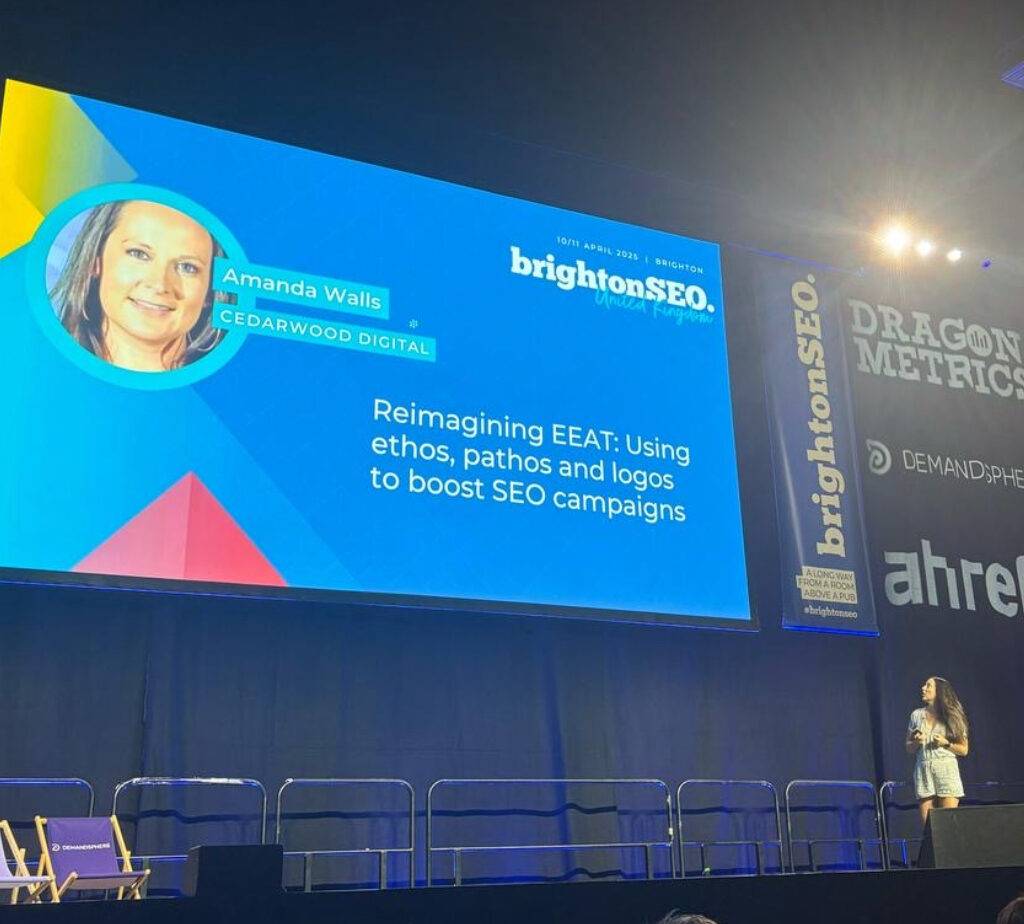
[blog]_[Director Amanda On The Main Stage @ Brighton SEO]_[Blog Picture]

Director Amanda On The Main Stage @ Brighton SEO

For her fourth time speaking at Brighton SEO, Director Amanda took to the main stage at Brighton SEO to deliver a talk on “Reimagining E-E-A-T: Using Ethos, Pathos And Logos To Boost SEO Campaigns” drawing on skills that she learnt when studying philosophy at school, Amanda discussed how the valuable rhetoric of Ethos, Pathos and Logos can be applied to SEO campaigns to not just improve performance, but most importantly to improve conversion rate and drive sales and leads – which at the end of the day is why everyone does it!

At the event which had over 2,000 attendees, Amanda went into detail about how to apply these principles to your SEO campaigns and why doing so plays such an important role in ensuring your maximising your return on investment. Key focus areas included:

  • Understanding that 87% of people will leave the conversion funnel if they read a negative review or mention of your website – brand perception and awareness is key and building/protecting your reputation plays a key role in this

  • Showcasing “benefits” not “features” – why should I use your product/service, what benefit does it have to me? Rather than just listing a specific feature it has, appeal to the user’s emotional side by helping them to understand how it could help them

  • Matching user intent plays an important role in keeping users in the funnel – understanding what type of content best resonates with them is important here, do they want content that showcases experience or expertise? Or sometimes do they want a mixture of both?

  • Utilising Digital PR effectively to build reputation – how to best use your thought leadership and data-led campaigns to make people find your brand online and ensuring that when people are researching they’re finding what they need to to better understand your brand.

Overall, the outline of the talk focused on how Aristotle utilised “rhetoric” to help persuade an audience to do something – not too different from what we try to do in modern day SEO and provided relatable takeaways that not only help to align E-E-A-T (specifically in YMYL industries) but also help to boost those all important conversion rates.

A big thankyou to everyone who attended the talk – please reach out if you’d like a copy of the deck!

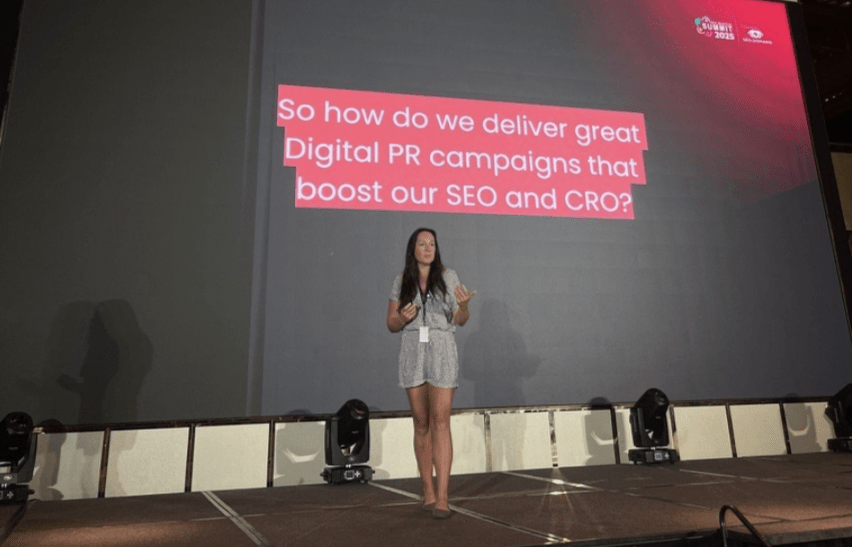
[blog]_[Director Amanda Walls Speaks At The SEO Mastery Summit, Saigon (Vietnam)]_[Blog Picture]

Director Amanda Walls Speaks At The SEO Mastery Summit, Saigon (Vietnam)

Our Director Amanda Walls was on stage at the SEO Mastery Summit, Saigon last week discussing “Using Digital PR To Simultaneously Boost SEO And CRO”

The SEO Mastery Summit is one of the most highly regarded SEO conferences in the world with nearly 500 delegates from around the world attending the week-long conference each year & Amanda was delighted to have been invited to speak at the event. The conference is held each year in Ho Chi Minh City and attracts a huge international audience.

“The SEO Mastery Summit is one of the leading SEO events in the world so it’s great to be able to get on stage and share knowledge with as well as learn from some of the world’s best SEO’s,” she said.

Also on stage, were leading SEO speakers including Craig Campbell, Kavi Kardos, SEO Jesus, Christopher Hofman and many more…

Key themes of the conference focused around the rise of AI and how we can adapt it into strategy to help improve efficiencies, as well as looking at personal branding and the rise of this within SEO. There were many cutting-edge talks discussing recent Google algorithm updates and how to stay ahead of the evolving landscape, as well as some great social networking events and a chance to meet SEOs from all over the world.

Overall, the conference had some great actionable takeaways to bring home for clients, in addition to being a great way to learn from and speak in front of some of the world’s leading SEOs.