A modern framework for diagnosing sustained organic decline across relevance, intent, technical SEO, authority and verifiable trust.
Organic traffic declines used to be relatively easy to diagnose.
A migration went wrong. A robots.txt rule changed. Important pages were accidentally noindexed. Rankings dropped after a major algorithm update. A competitor simply started doing SEO better.
Those problems still happen.
But some of the most difficult SEO challenges we see today look very different.
There is no catastrophic overnight fall. There is no manual action. There may not even be one obvious algorithm update that explains what happened.
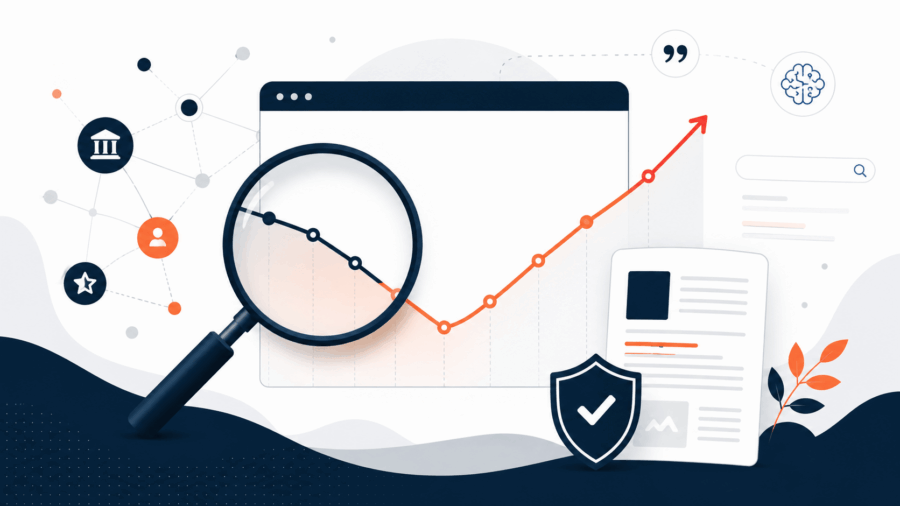
Instead, visibility slowly erodes.
A position-three keyword becomes position five. Position five becomes position nine. Pages that previously dominated a topic start competing with each other. Featured snippets disappear. Long-tail traffic weakens. Competitors gradually take a larger share of the SERP.
Six, 12 or 18 months later, the website is generating substantially less organic traffic – despite publishing new content, updating old content, fixing technical issues and perhaps even continuing to build links.
At this point, simply asking “what caused the traffic drop?” is often the wrong question.
What has changed about Google’s confidence that this website is one of the best sources to surface for these queries?
That distinction matters.
Modern organic recovery requires us to look beyond rankings and individual pages and evaluate the entire ecosystem around a website: technical accessibility, search intent, topical structure, content purpose, external authority, entity signals, reputation and user preference.
Google itself recommends investigating traffic drops across several possible causes rather than automatically attributing them to an algorithm update, including technical issues, spam issues, changing search demand, migrations and ranking changes.
So when organic performance declines, the first job isn’t to start changing things.
It’s to diagnose what type of decline you’re actually dealing with.
Step one: understand the shape of the decline
Before undertaking an audit, look at the trajectory.
The shape of a traffic decline often provides clues about where to investigate.
An immediate cliff-edge decline might indicate a technical problem, migration issue, manual action or major ranking reassessment.
A seasonal decline may simply reflect falling demand.
A gradual decline across many months is different.
This is particularly interesting when:
- rankings are falling across both commercial and informational queries;
- multiple sections of the website are affected;
- competitors are progressively gaining visibility;
- there is no obvious indexing catastrophe;
- content updates provide only temporary improvements;
- previously strong pages repeatedly fall back after being refreshed.
In these situations, we’re probably not looking for one broken title tag.
We’re looking for a systemic competitive disadvantage.
In one recovery analysis, an 18-month decline had affected high-intent and long-tail keywords simultaneously, while the brand had moved from one of the stronger visibility positions in its competitor set to one of the weakest. That pattern was important because it suggested the issue needed to be addressed at a broader website level, rather than by simply refreshing a handful of individual pages.
This is why your first recovery report should segment the decline.
Brand vs non-brand
Has generic visibility fallen while branded traffic remains resilient?
Commercial vs informational
Are money pages declining faster than guides, or is the loss site-wide?
Page type
Compare services, categories, locations, guides, tools and editorial content independently.
Topic
Has one subject area collapsed while another remains stable?
Position movement
A fall from position two to four can create a large traffic reduction without looking dramatic in average-ranking data. Google specifically recommends distinguishing small position changes from genuinely large ranking losses when diagnosing declines.
Clicks vs impressions
Falling impressions may indicate lost visibility or demand. Stable impressions with falling clicks may point towards SERP changes, weaker positions or changing click behaviour.
Don’t start with solutions. Start by determining where confidence appears to have been lost.
Step two: stop assuming that more content is the solution
One of the most common responses to declining organic traffic is:
“We need to publish more content.”
Sometimes you do.
Frequently you don’t.
AI has dramatically reduced the cost of producing acceptable written content. As a result, simply possessing a 2,000-word guide covering the same entities and subtopics as every competitor is increasingly unlikely to create a meaningful competitive advantage.
Google’s own people-first content guidance explicitly warns against creating large quantities of content primarily to attract search traffic, writing outside your genuine area of expertise or summarising what other people have already said without adding substantial value.
This changes the role of a content audit.
Don’t just ask:
Is this page optimised?
Ask:
Why should this page exist?
Then:
Why should Google prefer this page to every other page satisfying the same query?
Those are very different questions.
A website can have technically competent content and still decline because its pages have become indistinguishable from the rest of the SERP.
Step three: audit intent before you audit keywords
One of the first areas I look at during a recovery project is intent clarity.
A common problem on mature websites is that pages gradually accumulate content.
A commercial landing page starts with a conversion-focused proposition. Then an FAQ is added. Then a 1,500-word SEO section. Then comparisons. Then definitions. Then related queries. Then another content refresh adds another 800 words.
Eventually the page is simultaneously trying to:
- sell;
- educate;
- compare;
- answer FAQs;
- rank for long-tail informational searches;
- explain the market;
- target several adjacent commercial keywords.
The result is technically comprehensive but strategically unclear.
This is a common pattern in recovery work: mixed commercial and informational intent can dilute transactional relevance, while multiple pages targeting overlapping intents can cause cannibalisation. The response should be clearer intent mapping, page-level NLP analysis, testing content positioning and CTAs, and improving internal linking to establish a clearer hierarchy.
That is a useful model for any website experiencing decline.
For every strategically important URL, define:
Primary intent -> Primary query family -> User stage -> Page purpose -> Conversion action
There should be very little ambiguity.
Commercial page
“I understand the solution. I am evaluating providers. Help me take action.”
Explainer page
“I need to understand the subject before deciding what to do.”
Comparison page
“I understand my options. Help me evaluate them.”
Trust page
“I am considering this company. Give me enough evidence to believe it is legitimate.”
Trying to make one URL fulfil every role can weaken all of them.
This becomes even more important as search extends beyond traditional SERPs into AI interfaces.
A cleaner architecture can deliberately separate:
- commercial pages designed primarily for human conversion;
- guides and explainers designed for information retrieval;
- trust and legitimacy content designed to answer risk and verification questions.
For higher-stakes searches, that can also mean incorporating clear definition blocks, step-by-step explanations and transparent risk disclosures.
The principle is simple:
One page doesn’t need to answer every possible question about a subject. It needs to perform its specific job exceptionally well.
Step four: find and resolve cannibalisation
Intent problems frequently lead directly to cannibalisation.
And cannibalisation isn’t simply “two pages contain the same keyword”.
The real problem is unclear ownership of an intent.
If Google repeatedly rotates several URLs for the same query, that can indicate that your site architecture isn’t clearly communicating which page is the definitive destination.
Map your important queries against URLs and look for:
- multiple pages swapping positions;
- location pages targeting essentially identical intent;
- blogs outranking service pages for commercial searches;
- guides competing with categories;
- legacy pages retaining links despite being superseded;
- internal links pointing to several competing URLs using similar anchors;
- canonicals and redirects contradicting your preferred hierarchy.
Then make decisions.
Merge pages where appropriate.
Redirect obsolete URLs.
Differentiate genuinely separate intents.
Strengthen internal links towards the canonical topic owner.
Rewrite overlapping pages rather than simply making each one longer.
The objective is clarity.
Search engines shouldn’t have to guess which URL represents your strongest answer.
Step five: check whether Google is actually experiencing your site the way you think it is
Content strategy won’t fix a website that Google struggles to crawl or interpret.
Technical audits during recovery therefore need to go beyond ticking off status codes and Core Web Vitals.
One particularly useful source is server log data.
Analytics tells us what users do.
Crawl tools tell us what a crawler can access.
Logs tell us what search engines are actually requesting.
For larger websites, log-file analysis can expose priority pages that receive surprisingly little crawling, orphaned sections, excessive bot activity on low-value URLs and internal-linking structures that fail to communicate commercial priorities.
During a recovery audit, investigate:
- indexability;
- canonicalisation;
- redirects and redirect chains;
- crawl patterns;
- orphaned URLs;
- duplicate and near-duplicate content;
- faceted navigation;
- XML sitemap quality;
- internal linking;
- JavaScript rendering;
- URL architecture;
- crawl waste;
- Core Web Vitals;
- mobile usability;
- structured data;
- site migrations and historical URL changes.
Google also recommends looking holistically at page experience rather than treating any single metric as the answer.
Technical SEO creates the conditions for recovery.
But technical SEO alone often isn’t enough to produce it.
Step six: understand the trust ceiling
This brings us to one of the most useful concepts when diagnosing prolonged organic stagnation:
The trust ceiling
“Trust ceiling” isn’t a Google metric.
There is no Trust Ceiling score hiding inside Google’s systems.
It’s a strategic way of describing something we increasingly observe in competitive organic search.
A website can have:
- technically strong architecture;
- well-optimised content;
- reasonable backlink metrics;
- relevant pages;
- competent internal linking;
…and still struggle to progress.
Why?
Because compared with the websites around it, there may simply not be enough independent evidence confirming that this entity should be trusted for this particular subject.
The website reaches the limit of what on-site optimisation alone can achieve.
That’s the trust ceiling.
This pattern is particularly visible in websites experiencing long, gradual declines rather than dramatic penalties: the business continues improving content and acquiring generic links, but competitors possess much stronger external validation in the niches that matter.
To understand whether this is happening, traditional backlink-gap analysis isn’t enough.
You need to audit three separate authority gaps.
Domain authority gap
At the simplest level, do competitors have materially stronger backlink profiles?
Useful – but this tells only part of the story.
Topical authority gap
What subjects are those backlinks validating?
Imagine two financial brands each have 1,000 referring domains.
Brand A’s links predominantly come from generic lifestyle, entertainment and syndicated news websites.
Brand B is repeatedly referenced by financial journalists, lending publications, consumer-finance organisations, accountants and regulatory commentators.
A raw referring-domain comparison could suggest parity.
A topical analysis tells a very different story.
Entity authority gap
Finally:
How strongly is the brand itself associated with the subject?
Who gets quoted by journalists?
Whose experts appear in industry coverage?
Whose research gets cited?
Which brand repeatedly appears alongside the entities, terminology and issues defining the sector?
This matters because external authority is broader than backlinks alone.
Coverage, expert commentary, mentions and semantic associations can collectively create clusters that repeatedly connect a brand with a specific field of expertise.
Step seven: close authority gaps with hyper-relevant Digital PR
This requires a different approach to Digital PR.
Historically, link acquisition was often treated as a numbers game:
More links = more authority.
But a link profile consisting of hundreds of disconnected publications doesn’t necessarily explain what a company is authoritative about.
Instead, ask:
Where does this brand need to appear for its expertise to make sense?
This is the basis of hyper-relevant Digital PR.
The aim isn’t to abandon national media or high-authority publications.
It’s to create the right blend of reach and relevance.
A smaller specialist industry publication may contribute far more to a particular authority cluster than a superficially impressive placement completely disconnected from the subject.
Relevance beats reach.
Industry publications, specialist journalists, targeted reactive commentary and highly specific thought leadership repeatedly reinforce the connection between brand + topic + expertise.
A recovery-focused PR programme might therefore include:
Niche commentary
Place genuine experts in the publications already influencing your target market.
Reactive newsjacking
Become a reliable expert source when stories relevant to your specialism break.
Original data
Create information journalists can’t obtain elsewhere.
Thought leadership
Develop distinctive viewpoints rather than rephrasing accepted industry wisdom.
Research assets
Turn proprietary data, FOI data, surveys and internal insight into genuinely referenceable resources.
Original research is particularly powerful because the brand becomes the origin of the information, rather than simply another website commenting on it.
Over time, the goal is to create authority clusters.
One relevant mention isn’t authority.
Repeated corroboration from multiple trusted sources around the same subject starts to create something much more defensible.
Step eight: move from E-E-A-T checklists to E-E-A-T 2.0
This is where traditional E-E-A-T audits also need to evolve.
First, an important clarification.
E-E-A-T is not a single Google ranking factor.
Google describes E-E-A-T as a collection of concepts represented by multiple signals, and its guidance identifies trust as the most important element. These considerations carry particular importance for YMYL subjects involving areas such as health, financial stability and safety.
The mistake is turning that guidance into a checklist.
Add an author box.
Add an About Us page.
Add five references.
Add a “reviewed by” label.
Done.
Except none of those elements proves very much by itself.
This is why I use an expanded framework I call E-E-A-T 2.0.
The shift is from:
declared trust -> verifiable trust.
Your website might say:
“We’re experts.”
But can that expertise be independently validated?
You might say:
“We’re award winning.”
Can those awards be verified elsewhere?
You might claim:
“Trusted by thousands of customers.”
Does independent evidence support that?
You might add an “expert reviewed” label.
Does the reviewer actually exist as an identifiable professional entity with credentials and a reputation outside your website?
The E-E-A-T 2.0 framework therefore focuses on three ideas:
- Verifiable identity.
- Verifiable claims.
- Verifiable reputation.
And underneath those sit five broader trust clusters.
1. Identity
Can search systems confidently determine who is behind the website?
That can include organisations, founders, authors, experts and reviewers.
Consistency matters.
2. Provenance
Where did the information come from?
Who created it?
What experience informed it?
Was it reviewed?
What methodology produced the data?
When was it updated?
Good provenance turns anonymous information into accountable information.
3. Reputation
What does the wider ecosystem say about you?
Relevant editorial mentions, reviews, references, citations, awards and industry recognition matter because reputation cannot be created entirely through self-declaration.
4. Compliance
Does the website behave like a responsible organisation in its sector?
That may involve editorial standards, regulatory transparency, policies, risk disclosures and appropriate governance.
It also means considering publishing behaviour itself. Producing enormous quantities of low-value content simply because keywords exist can create the opposite impression from genuine expertise.
5. Demand
Do people actually choose the brand?
Branded searches, brand-plus-category searches, direct navigation and repeat behaviour can provide useful indicators of genuine market preference.
Together, these five areas create what I call a Trust Graph.
Trust isn’t generated by one author bio. It emerges when multiple independent signals consistently corroborate each other.
A useful question during any recovery audit is therefore:
If your website disappeared tomorrow, would the rest of the web still confirm your expertise?
If the answer is no, you have identified an important vulnerability.
Step nine: build trust infrastructure, not just trust pages
This distinction is important.
Don’t respond to a trust problem by creating a new “Why Trust Us?” page containing 1,500 words written by the marketing team.
Instead, build infrastructure that makes trust easier to verify.
Depending on the organisation, that could include:
- editorial standards;
- expert profile hubs;
- detailed author biographies linked to independently verifiable profiles;
- content review processes;
- transparent update histories;
- original research centres;
- methodology pages;
- complaints policies;
- regulatory information;
- clear business details;
- independent review profiles;
- case studies with verifiable outcomes;
- industry memberships;
- expert speaking and commentary;
- data sources;
- appropriate citations.
The distinction is moving from isolated assets towards repeatable systems: editorial standards demonstrate governance, expert hubs connect content with identifiable expertise, methodology disclosures explain how conclusions are reached, and research centres create material genuinely worth citing.
This is significantly harder to fake.
And that’s the point.
Step ten: create a recovery flywheel rather than chasing individual ranking wins
Successful organic recovery rarely comes from one magical optimisation.
It comes from several improvements beginning to reinforce each other.
Better intent alignment improves relevance.
Better architecture strengthens topic ownership.
Better content satisfies users more effectively.
Better technical structure improves discovery and consolidation.
More relevant external coverage strengthens authority.
Stronger expert visibility improves entity associations.
Greater visibility creates more opportunities for users to encounter the brand.
Greater recognition can increase selection.
That selection creates more visibility.
And the cycle starts again.
Trust -> Visibility -> Selection -> Reinforcement -> More Trust.
It’s also why shortcuts tend to plateau.
Buying another 50 links might temporarily move a metric.
Publishing another 100 AI-generated articles might increase indexed-page count.
Adding another 2,000 words to a commercial landing page might make your content score turn green.
But none necessarily creates a reinforcing ecosystem of relevance, authority and genuine user preference.
And then AI search raises the threshold again
This approach matters beyond traditional Google rankings.
Search is increasingly becoming an environment where systems don’t simply retrieve ten possible answers.
They synthesise information.
That creates another decision:
Which sources are trustworthy enough to include, reference or cite?
Google’s current guidance for its AI search experiences still emphasises fundamentally familiar principles: unique and useful content, good page experience and making content technically accessible to Search.
But strategically, the implication is significant.
SEO has traditionally focused heavily on ranking eligibility.
Generative search increasingly introduces another consideration:
citation eligibility.
Can the system confidently understand:
- who you are;
- what you specialise in;
- where your information came from;
- whether other trusted entities corroborate your expertise;
- whether your brand is consistently associated with this topic?
That makes topical PR, original research, identifiable expertise and strong provenance increasingly valuable assets.
The objective isn’t simply to make a page relevant to a keyword.
It’s to make the organisation a credible source for the subject.
A practical organic traffic recovery framework
When I approach a sustained organic decline today, I work through five interconnected layers:
1. Diagnose
Understand when, where and how visibility declined.
Separate algorithmic changes from technical problems, changing demand, SERP changes and genuine competitive loss.
2. Relevance
Map every important page to a clear intent.
Resolve cannibalisation.
Improve topic ownership, internal linking, page purpose and content alignment.
3. Technical foundations
Ensure search engines can efficiently discover, crawl, render, understand and consolidate the pages that matter.
Use crawl data, Search Console and – where possible – server logs rather than relying on a single audit tool.
4. Trust
Audit identity, provenance, reputation, compliance and demand.
Ask whether claims made on the website can be independently verified.
5. Authority
Compare your external authority at domain, topical and entity level.
Then use hyper-relevant Digital PR, expert commentary, original research and specialist coverage to close the gaps that actually matter.
These activities shouldn’t happen sequentially.
A strong recovery strategy addresses them in parallel.
That might mean beginning technical auditing while remapping high-intent pages, while Digital PR starts building external signals from day one.
Because recovery isn’t usually about fixing one broken thing.
It’s about rebuilding confidence across the entire organic ecosystem.
What should you measure during an SEO recovery?
Traffic and rankings still matter.
But they shouldn’t be your only measures.
I’d also track:
High-intent visibility
Are commercially important query clusters actually recovering?
Cannibalisation
Is one preferred URL increasingly becoming the stable ranking page?
Competitor share of visibility
Are you reclaiming ground rather than simply gaining impressions in isolation?
Qualified organic conversions
Recovery should ultimately reach commercial performance.
Relevant authority growth
Are you gaining coverage in the subject areas where competitors historically dominated?
Mention quality
Who is talking about the brand, and in what context?
Entity consistency
Is the same expertise being reinforced across your website, media coverage, expert profiles and third-party sources?
Branded search
Is market demand for the brand itself changing?
SERP feature visibility
Are you winning snippets and other enhanced search features?
AI citations and mentions
Is the brand appearing as a source or recognised entity in relevant generative searches?
Recovery should be measured as growing confidence, not simply a line moving upwards in Semrush.
The biggest mistake: fixing symptoms instead of causes
When a website has been declining for a year, the temptation is to search for one explanation.
“It was the core update.”
“We need better content.”
“We don’t have enough backlinks.”
“Our Core Web Vitals aren’t good enough.”
“The domain isn’t authoritative enough.”
Perhaps.
But prolonged organic decline is often cumulative.
Your commercial pages become less aligned with intent.
Content starts competing with itself.
Competitors improve.
Your external authority remains generic while theirs becomes more relevant.
Your authors have limited external footprint.
Your claims are difficult to verify.
Your content architecture expands without strong governance.
User preference moves elsewhere.
Each weakness might be relatively small.
Collectively, they change which website looks like the safer, clearer, more authoritative answer.
And that’s why recovery requires a coordinated strategy rather than another content refresh.
The future of organic recovery is about rebuilding confidence
One of the most useful principles in Google’s quality guidance is that trust sits at the centre of E-E-A-T.
That doesn’t mean technical SEO is obsolete.
It doesn’t mean content doesn’t matter.
And it certainly doesn’t mean there is a mysterious “trust score” that agencies can optimise.
It means that relevance, technical quality, experience, external authority, reputation and user signals increasingly need to make sense together.
So if your organic traffic has been declining despite repeated optimisation, stop asking:
What else can we add to the website?
Start asking:
What evidence is missing that would make this website the obvious source to trust?
Sometimes the answer will be content.
Sometimes it will be architecture.
Sometimes it will be intent.
Sometimes it will be technical.
And sometimes you’ll discover that you have simply reached a trust ceiling that no amount of on-page optimisation can break.
That’s when the recovery strategy needs to extend beyond the website itself.
Because increasingly, what you say about your expertise matters less than whether the rest of the web can verify it.
Relevance gets you considered. Trust gives you staying power.



![[blog]_[Last night's UK Search Awards Wins!]_[blog picture]](https://cedarwood.digital/wp-content/uploads/2025/12/Copy-of-Copy-of-industry-insights-template-1-900x506.png)
![[blog]_[SEO Content Writing - Stripped Back to the Basics]_[blog picture]](https://cedarwood.digital/wp-content/uploads/2025/12/image-5-900x506.png)
![[blog]_[Best Christmas Campaigns Over The Years]_[blog picture]](https://cedarwood.digital/wp-content/uploads/2025/12/Copy-of-Copy-of-Copy-of-Copy-of-blog-sneak-peak-template-1-900x506.png)
![[blog]_[lessons weve learnt in 2025]_[Blog Picture]](https://cedarwood.digital/wp-content/uploads/2025/10/things-weve-learnt--900x506.png)