Relevancy – you’ve probably heard this term buzzing around LinkedIn recently and may be wondering: is it just another industry fad, or does it actually matter?
Why Collaboration Between SEO and Digital PR Is So Important
In the dynamic world of digital marketing, the crossover between SEO and Digital PR is becoming increasingly vital. SEO and Digital PR are both crucial if you are looking to increase your brand visibility and online presence, and even though they can be viewed as separate roles, collaboration is absolutely essential. By collaborating your SEO and Digital PR strategies, you can successfully achieve brand awareness, increased visibility and more sales.
In the past, Digital PR agencies and SEO have been seen as completely separate entities, both completed by separate teams with no involvement. However, as high quality links and brand reputation have become more important for improving organic search results, collaboration between SEO and DPR is now extremely valuable. By integrating the two, both elements work together to increase each other’s impact.
Why Is Integrating SEO And Digital PR Essential?
- ➡️ Enhanced Online Visibility
SEO and Digital PR both aim to increase a brand’s online visibility. While SEO efforts focus on on-page efforts, DPR focuses on off-site but both can have a massive impact on driving more organic traffic to a website. When SEO and DPR teams work together, they can target the same areas of a website, and produce on-site and off-site content to increase rankings and visibility.
When SEO and Digital PR teams work together, they can identify high-value opportunities and target these together to increase visibility. Quality backlinks from Digital PR efforts can enhance domain authority, making it easier for SEO initiatives to achieve better results in the SERPs, alongside on-site optimisations, this can have a huge impact on SEO performance.
Successful Digital PR strategies can also drive targeted traffic to your website and this is a great opportunity for SEO teams to provide Digital PR teams with information about high intent traffic which will be valuable for the brand and the Digital PR team can then use this data to inform their strategies and create campaigns that will attract the right type of traffic. This collaboration can work really well and generate high intent users for your website. Product placements are an example where this can be extremely effective.
- ➡️ High Quality Content
Combining SEO’s data driven approach to keyword research with PR’s storytelling expertise can result in content that ranks well and engages readers. Both teams can ensure that the content is interesting for users, but also optimised for search engines, and this can also make it compelling enough to attract media attention. Sometimes, you don’t even need to outreach your Digital PR work, you can make the journalists come to you – by targeting relevant keywords and providing data hubs within your content, you can gain natural backlinks without the need for any contact with journalists. However, in order for this to work successfully, it is absolutely imperative that the SEO and Digital PR experts are working together. You can read more about this reverse digital pr strategy in our blog talking all about reverse Digital PR and how it works.
High quality content is a must for SEO and Digital PR, and by working together, you can create content that is fit for both SEO and Digital PR purposes.
- ➡️ Building Brand Authority And Trust
Building brand authority and E-E-A-T (Experience, Expertise, Authority and Trust) signals is essential for organic performance and one of the many ways to do this and potentially one of the most direct crossovers between SEO and Digital PR is link building. Gaining high quality backlinks from reputable sites is key for SEO performance – it will make the brand more trustworthy in the eyes of search engines and consumers and it can significantly boost the website’s authority and online visibility. This therefore makes Digital PR an essential part of all modern SEO strategies and when both teams work together seamlessly, it can make this process much more effective.
- ➡️ Measuring Success
Having a unified approach between SEO and Digital PR will also allow for a more comprehensive set of metrics to measure campaign success. By combining SEO and Digital PR data and analytics, you can gain deeper insights into how both efforts are performing together and adjust your strategies accordingly.
Overall, incorporating your SEO and Digital PR strategies goes much further than immediate online visibility but it helps build a strong foundation for long term success in the online space. By understanding these benefits, you can effectively collaborate your SEO and DIgital PR efforts to create an extremely strong online presence.
How Can Digital PR And SEO Teams Collaborate?
- ➡️ Align Strategies
The first step when Digital PR and SEO teams are collaborating on any project or account is to start working together from the very beginning. Both teams should align their objectives and these can be increasing organic traffic, enhancing brand awareness and visibility, or boosting engagement – whatever the goals and objectives are, it is important that both teams are on the same page so that all strategies and projects moving forwards are focused on the same outcomes.
- ➡️ Share Keyword Research and Insights
SEO teams should consistently share keyword research and insights with the Digital PR team so that they can be aware of topics that are newsworthy and have a high search potential. This can help to inform strategy for Digital PR campaigns and ensure they are relevant, but it can also help ensure that all Digital PR content is optimised for SEO from the outset so that it can be uploaded to the website for SEO purposes as well as outreached for Digital PR.
- ➡️ Coordinate Content Creation
High quality content takes time to write, and with both SEO and Digital PR teams having expertise in content creation, these teams should definitely be sharing their content with each other. Digital PR teams will often be creating data hubs of content that would be absolutely perfect for the website, by sharing this content, the SEO team can ensure it is targeting the right keywords and once this has been uploaded to the website, it can attract traffic and potentially even receive natural backlinks – a win win situation which would have potentially have been missed if there was no crossover between the two teams. Likewise, SEO teams will also be creating highly targeted content that the Digital PR team can utilise for their benefit as well.
- ➡️ Cross Team Collaboration
Overall, creating collaboration between SEO and Digital PR teams needs to focus on consistent communication and teamwork between both teams. This can be achieved through joint training sessions, regular check-ins, collaborative brainstorming and shared tracking tools to ensure everyone is at the same stage throughout the whole strategy.
Summary
For any business looking to enhance their online presence, it is absolutely essential that Digital PR and SEO teams are working together. When these two teams collaborate, they can create a cohesive strategy that will amplify the impact of both efforts. High quality backlinks from reputable media sources can significantly impact SEO results, and SEO insights can guide DPR efforts to target topics that will drive high intent traffic and engagement.
The synergy between Digital PR and SEO will not only maximise brand exposure and authority, but will also ensure a strategic approach to content creation and online marketing, ultimately leading to increased visibility, traffic and conversions for the business.
At Cedarwood Digital, our SEO and Digital PR teams are constantly working together to drive online visibility for a range of businesses. If you are looking to boost the online presence of your business through Digital PR and SEO, make sure to get in touch with us today.
A Guide For E-commerce Digital PR
There’s no question that e-commerce is thriving; e-commerce sales are forecasted to make up a huge 23% of global retail sales by 2027. We’re seeing social media platforms increasingly integrating shopping features and live shopping experiences gaining traction on platforms like TikTok. We’re certainly in a new era of e-commerce but how can traditional e-commerce sites still ensure they’re getting seen? The answer is link-building. It’s an absolute necessity for e-commerce businesses aiming for growth and brand recognition.
This guide is going to explain exactly what you’re missing out on if digital PR isn’t yet part of your e-commerce strategy and give you the techniques our experts can’t live without.
Why your e-commerce site needs digital PR
In this saturated market, customers now, more than ever, need to really trust a brand to want to purchase from them. In fact, according to Edelman’s Trust Barometer, Gen Z exhibits the highest need for brand trust, with 79% saying it is more important to trust the brands they buy today than in the past. Digital PR is the key to building that trust and establishing your brand as an authority.
But alongside this, digital PR helps strengthen your brand image, attract relevant traffic and boost your organic search ranking for competitive keywords. When high-quality external sites link to your e-commerce store, search engines perceive your website as more authoritative and trustworthy. This translates to improved rankings for relevant keywords in search engine results pages – bingo.
A well-crafted digital PR strategy will secure backlinks not just to your homepage, but also to product and category pages. This “deeper link building” helps you rank higher for specific products and high-intent pages in the SERPs.
If your e-commerce site has physical stores, digital PR will also work in your favour. Press releases can be outreached to specifically target local publications, building brand awareness in your local community.
Plus, the benefits of digital PR extend to your paid campaigns too, enhancing their performance and maximising your return on investment. This is because digital PR can generate positive brand mentions and reviews online and, by incorporating reviews into your landing pages, you add social proof and enhance the credibility of your paid ads.
Whilst things like brand awareness and credibility are important, what we’re all ultimately after in e-commerce is a boost in sales. Digital PR goes beyond vanity metrics – each link, brand mention, and boost in authority helps an e-commerce site outrank their competitors, and get customers on their side. In other words, you significantly increase your conversions!
How to do digital PR for e-commerce: our tips
🧷Product placements
On the topic of trust, product placements are your golden ticket. If a trusted reviewer (say GQ or Vogue) features your new sandal range in their ‘22024 summer holiday must-haves’ list, that’s a powerful way to earn trust and stand out – in a natural way. These high-authority platforms have thousands of readers, and therefore, just as many potential customers for your products.
Focus on reaching out to publications and review websites that resonate with your brand values. And remember that product placement isn’t just a transaction – you want to build a relationship. Offer journalists early access to new products, and provide valuable industry insights alongside your product details.
We leveraged this technique successfully with our garden furniture client, Hayes Garden World. We used a mixture of media monitoring, and proactive outreach to get our products featured. With this approach, we landed over 65 linked product placements in a year, with £47,000 in referral sales generated! Told you product placements work. Make sure to have a Dropbox file of high-resolution images ready to go, so you can jump on trends and turn a product placement around quickly.
🧷Internal data
Due to the online interactions on an e-commerce site, they have a far bigger pool of internal data compared to traditional stores. This is because e-commerce sites can track every click, search and product interaction, which provides heaps of insight into browsing habits and product preferences. Additionally, e-commerce platforms often collect customer information like their demographics and purchase history.
Why does this matter? Sales data and customer behaviour patterns can be the foundation for compelling digital PR stories that will stand out in journalists’ inboxes and secure you those valuable links. This is completely unique data and analysis that only you have access to and will attract outlets looking for fresh, data-driven content. It’s also worth analysing customer data anyway to help you tailor your digital PR messaging. Internal data can help you understand your audience’s wants, needs and pain points, which will inform more effective campaigns.
🧷Content marketing
Great content is a magnet for backlinks and serves as a relatively low-maintenance technique to help attract customers and journalists to your site. We call this approach ‘reverse digital PR’ and here’s how it works:
- Start by analysing your website to identify areas where you could establish yourself as a data hub. This could be through informative blog posts, buying guides, in-depth industry reports, or even infographics. Consider what information your target audience is after and what content gaps exist within your niche.
- Whilst not essential, incorporating data into your content will boost its authority and newsworthiness. You can leverage internal sales data, customer behavior patterns, or commission external surveys, all to produce content that’s unique and engaging.
- Present this information in a clear and visually appealing way, then optimise your content with keywords to ensure it ranks well in the SERPs. If it isn’t ranking, how are journalists and customers going to find it!
- Now, you can sit back and watch as you attract backlinks naturally, without the need for constant outreach. Journalists and other websites looking for insightful information to add credibility to their articles, will come across your data and (hopefully) link back, boosting your site’s authority and visibility.
🧷Guest-posting
Guest posting allows you to share your expertise and build valuable backlinks to your e-commerce site. The way this works is you contribute an informative article to relevant industry publications with larger audiences. You’ll then ideally receive a do-follow backlink within the guest post, which acts as a vote of confidence, boosting your site’s authority and ranking. Equally, guest posting exposes your brand and products to a wider audience, and this increased visibility leads to more traffic and potential sales.
🧷Keep your eye out for unlinked mentions
Even mentions of your brand that don’t link to you are valuable – identifying them using a tool like Google Alerts allows you to then reach out to the site owner or article author. Offer additional information or propose a content collaboration, and this could potentially lead to a backlink. Even if you don’t secure a link, this mention is still increasing your brand awareness by getting your name in front of a new audience, so don’t discount it!
Whether you sell dog bowls, windshields, or Bakewell tarts, you’re setting yourself up for success by following the steps in this guide. In 2024, prioritising digital PR within your e-commerce digital marketing strategy is a need and a must. Without it, you’re missing out on valuable links, traffic, and most importantly, paying customers!
Cedarwood Digital is an award-winning digital PR agency specialising in landing reputable links and coverage for e-commerce businesses. If you’re looking for a hand with your digital PR, go ahead and drop us a message – we’d love to hear from you.
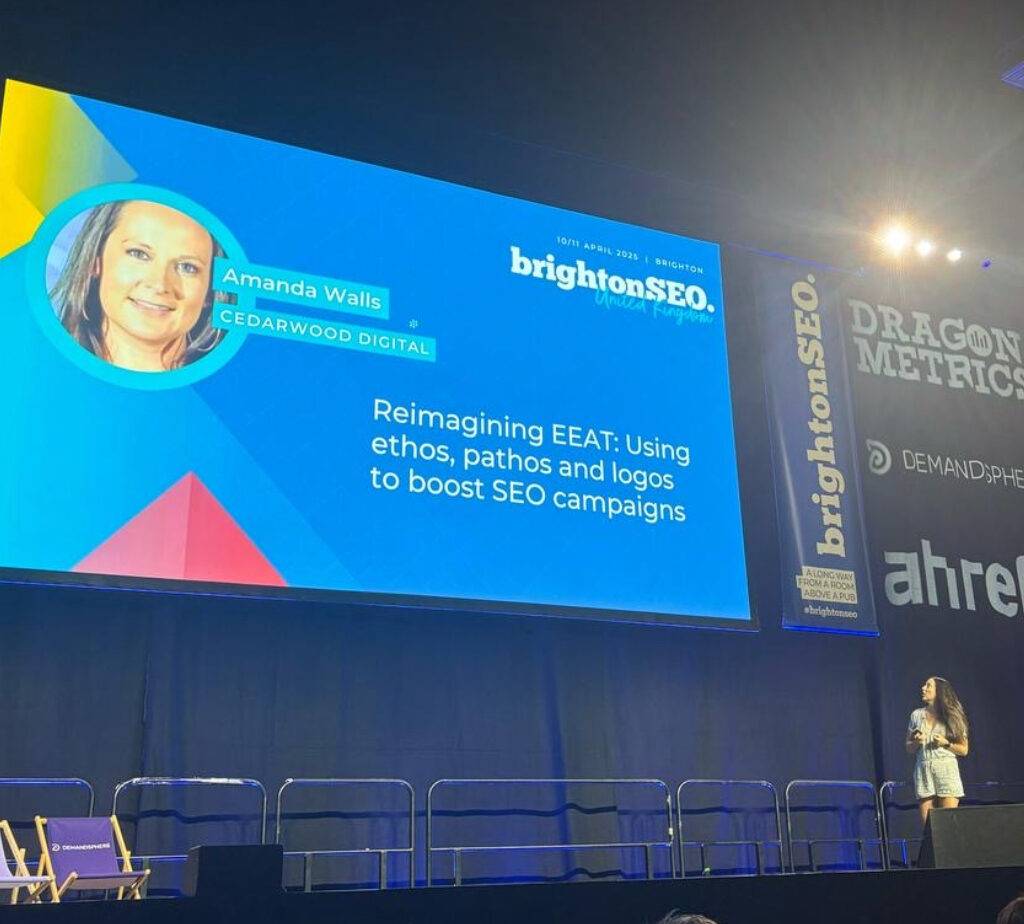
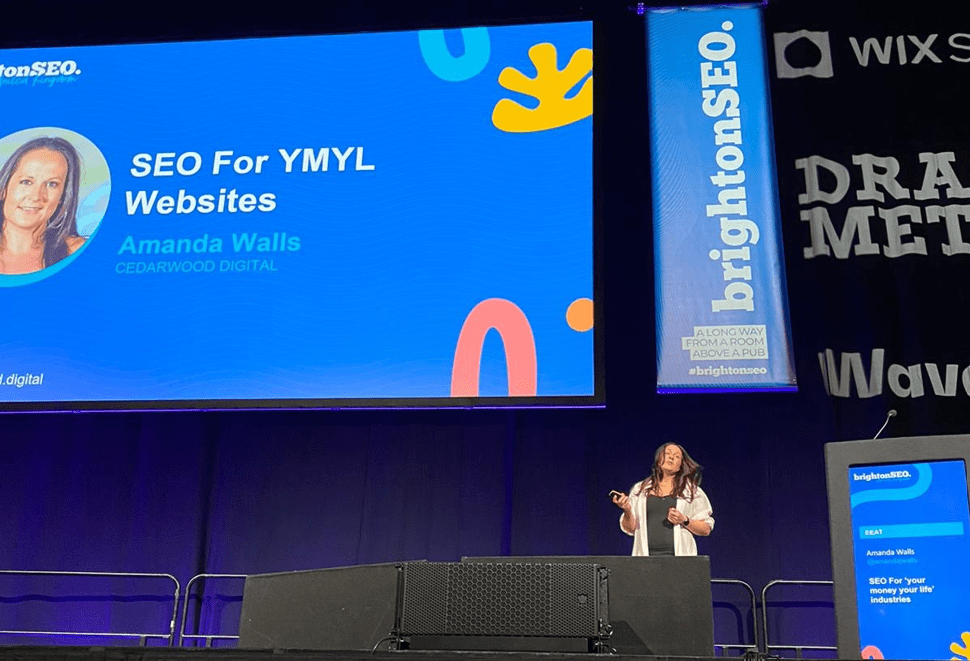
Director Amanda On The Main Stage At Brighton SEO
Having attended Brighton SEO for over a decade now, I can safely say that it’s one of the best, if not the best SEO conference in the world, so I was absolutely delighted when asked to speak on the main stage this year covering the topic “SEO For YMYL Websites”
For those of you that don’t know what YMYL is, it stands for “Your Money Your Life” and it’s a term that was coined by Google to cover websites that can have an impact on someone’s money or life. At Cedarwood, we specialise in working with companies like this and with years of experience building links in particularly tricky industries i.e. gaming, vaping, medical, legal so it was great to be able to share some knowledge about this with the community.

So what were some of the key takeaways from the talk?
- User intent is key – matching user intent plays a huge role in the YMYL space and it’s really important that we are keeping this in mind. This ties in really well with the idea of creating a “satisfying amount of content” – that is the right amount of content for a user, not a certain number of words, to answer the questions/queries they might have and allow them to make an informed decision
- Reputation is important – in particular your external reputation. Google yourself – see what people are saying about you and make sure that you work to build your reputation with effective Digital PR – this will go a long way to helping what people have to say about you and also what Google are seeing being said about you
- Showcase your trust signals – whether it’s through industry accreditations or simply by telling people why they should trust you, showcasing this on your website and on external websites plays an important role on building those all important E-E-A-T signals
- And on the topic of E-E-A-T, making sure that it shines through in everything that you do. Google have openly stated that for YMYL websites they place a heavier weight on E-E-A-T signals so it’s important that those are showcased at every opportunity
- Finally, making sure that the look and feel of your content matches the expertise of it – there’s no point having great content only for it to look “amateurish” – take time to consider the way content is displayed and that it matches the expertise you are showcasing.
I had a great time in Brighton, got to meet some fantastic people and hear from some thought leaders across the industry.
You can find a link to my full slide deck here: https://www.slideshare.net/slideshow/amanda-walls-brighton-seo-seo-for-ymyl-websites-9pptx/267570020
Until October!

70 Free Data Sources For Your Digital PR Campaigns (All In One Place!)
Over the last few months I’ve spent a lot of time talking about Creating Low Cost High Return Digital PR campaigns – but in order to do that, knowing where to go for free data is a huge bonus!
Below we’ve compiled a quick list of 70 great (free) data sources that you can use for your Digital PR campaigns, so if you are looking for inspiration for your next piece of data analysis, look no further!
Government Agencies:
- Office for National Statistics (ONS): Extensive economic, social, and demographic data. (https://www.ons.gov.uk/)
- Department for Business, Energy & Industrial Strategy (BEIS): Data on business sectors, energy, and innovation. (https://www.gov.uk/government/organisations/department-for-business-energy-and-industrial-strategy)
- Department for Education (DfE): Education and skills data at national and regional levels. (https://www.gov.uk/government/organisations/department-for-education)
- Food Standards Agency (FSA): Data on food safety, diet, and nutrition. (https://www.food.gov.uk/)
- Environment Agency: Environmental data on pollution, water quality, and waste. (https://www.gov.uk/government/organisations/environment-agency)
Industry Associations & Research Bodies:
- Chartered Institute of Personnel and Development (CIPD): Data on HR practices, workforce trends, and employee engagement. (https://www.cipd.org/en/)
- Federation of Small Businesses (FSB): Data on small business demographics, challenges, and growth. (https://www.fsb.org.uk/)
- Retail Economics: Retail sales data and insights into consumer spending behavior. (https://www.retaileconomics.co.uk/)
- Centre for Cities: Research and data on urban economies and city development. (https://www.centreforcities.org/)
- The Work Foundation: Research on work, employment, and the changing nature of jobs. (https://www.lancaster.ac.uk/work-foundation/)
Public & Academic Institutions:
- Bank of England: Economic data, policy decisions, and financial market analysis. (https://www.bankofengland.co.uk/)
- Resolution Foundation: Research on living standards, poverty, and inequality. (https://www.resolutionfoundation.org/)
- National Institute of Economic and Social Research (NIESR): Independent economic research and forecasting. (https://www.niesr.ac.uk/)
- Joseph Rowntree Foundation: Research on poverty, inequality, and social justice. (https://www.jrf.org.uk/)
- The Health Foundation: Independent research on health and social care issues. (https://www.health.org.uk/)
Business & Consumer Data Providers:
- Statista: Global market research data and statistics on various industries. (https://www.statista.com/)
- Euromonitor International: Market research data and insights on consumer trends. (https://www.euromonitor.com/)
- Kantar Worldpanel: Consumer behavior and purchase data across various product categories. (https://www.worldpanel.com/)
- Nielsen: Market research data on media consumption, advertising, and consumer trends. (https://www.nielsen.com/)
- GfK: Market research data on consumer behavior, retail sales, and brand preferences. (https://www.gfk.com/home)
Data Portals & Open Data Initiatives:
- Data.gov.uk: Open data platform from the UK government. (https://www.data.gov.uk/)
- London Datastore: Open data platform for London. (https://data.london.gov.uk/dataset)
- Scotland’s Open Data Platform: Open data platform for Scotland. (https://opendata.scot/)
- Open Data Wales: Open data platform for Wales. (https://datamap.gov.wales/)
- Northern Ireland Open Data Platform: Open data platform for Northern Ireland. (https://www.nidirect.gov.uk/articles/open-data)
News & Media Resources:
- BBC News: News data and statistics from the BBC. (https://www.bbc.co.uk/news)
- The Guardian: Data journalism and interactive features from The Guardian. (https://www.theguardian.com/)
- The Times: News data and analysis from The Times (may require free registration). (https://www.thetimes.co.uk/)
- The Telegraph: Data journalism and interactive features from The Telegraph (may require free registration). (https://www.telegraph.co.uk/)
- Financial Times: Financial data and analysis from the Financial Times (may require free registration). (https://www.ft.com/)
- Sky News: News data and statistics from Sky News. (https://news.sky.com/)
Trade Associations & Professional Bodies:
- Confederation of British Industry (CBI): Business surveys and economic forecasts. (https://www.cbi.org.uk/)
- Institute of Directors (IoD): Data on director attitudes and business decision-making. (https://www.iod.com/)
- Chartered Institute of Marketing (CIM): Data on marketing trends, consumer behavior, and advertising effectiveness. (https://www.cim.org/)
- Institute of Chartered Accountants in England and Wales (ICAEW): Data on financial reporting, accounting practices, and business confidence. (https://www.icaew.com/)
- Law Society of England and Wales: Data on legal trends, access to justice, and the legal profession. (https://www.lawsociety.org.uk/)
- Royal Institution of Chartered Surveyors (RICS): Data on property prices, housing market trends, and construction activity. (https://www.rics.org/)
- The Chartered Institute of Logistics and Transport (CILT): Data on logistics, transport, and supply chain management. (https://www.ciltuk.org.uk/)
Retail & Consumer Insights:
- British Retail Consortium (BRC): Retail sales data and insights into consumer spending trends. (https://www.brc.org.uk/)
- Office for National Statistics – Retail Sales:
- IMRG Capgemini Online Retail Index: Data on online retail sales and e-commerce trends.
- Which?: Consumer research and product reviews from Which?. (https://www.which.co.uk/)
- MoneySavingExpert: Consumer finance data, price comparisons, and money-saving tips. (https://www.moneysavingexpert.com/)
Social Media & Online Trends:
- Google Trends: Track search trends and see what people are interested in. (https://trends.google.com/)
- Sprout Social: Social media analytics and insights (free trial available). (https://sproutsocial.com/)
- Brandwatch: Social media listening and analytics platform (free trial available). (https://www.brandwatch.com/)
- Buzzsumo: Content marketing insights and influencer identification tool (free trial available). (https://www.buzzsumo.com/)
- Talkwalker: Social media monitoring and analytics platform (free trial available). (https://www.talkwalker.com/)
Sustainability & Environmental Data:
- Committee on Climate Change (CCC): Independent advice on tackling climate change in the UK. (https://www.theccc.org.uk/)
- Met Office: Weather data, climate change information, and environmental data. (https://www.metoffice.gov.uk/)
- UK Green Building Council (UKGBC): Data on sustainable construction and green building trends. (https://www.ukgbc.org/)
Health & Wellbeing Data:
- The King’s Fund: Independent health research and analysis. (https://www.kingsfund.org.uk/)
- NHS Digital: Health data and statistics from the National Health Service. (https://digital.nhs.uk/)
- Mental Health Foundation: Data on mental health and wellbeing in the UK.
- Cancer Research UK: Cancer statistics and research data. (https://www.cancerresearchuk.org/)
Education & Skills Data:
- Department for Education – Education & Training Statistics: Education and training statistics from the Department for Education.
- Ofqual: Data on qualifications, assessment, and regulation in education. (https://www.ofqual.gov.uk/)
- The Sutton Trust: Research on social mobility and education. (https://www.suttontrust.com/)
- The Higher Education Policy Institute (HEPI): Research and analysis on higher education policy. (https://www.hepi.ac.uk/)
Transport & Travel Data:
- Department for Transport (DfT): Transport statistics and data on roads, railways, and aviation. (https://www.gov.uk/government/organisations/department-for-transport)
- Civil Aviation Authority (CAA): Data on air travel, airports, and aviation safety. (https://www.caa.org.uk/)
- National Highways: Data on traffic flow and road conditions on motorways and major A roads in England. (https://www.nationalhighways.co.uk/)
Culture & Entertainment Data:
- Office for National Statistics – Culture, Media & Sport: Data on cultural participation, leisure activities, and the creative industries.
- Arts Council England: Data on arts funding, cultural participation, and the creative economy. (https://www.artscouncil.org.uk/)
- Barbican Centre: Data on audience engagement and trends in performing arts. (https://www.barbican.org.uk/)
- British Film Institute (BFI): Data on the UK film industry, cinema attendance, and audience preferences. (https://www.bfi.org.uk/)
Public Opinion & Polling Data:
- YouGov: Polling data on public opinion and social attitudes (free basic account available). (https://yougov.co.uk/)
- Ipsos MORI: Polling data on public opinion, social issues, and political attitudes. ([invalid URL removed])
- NatCen Social Research: Social research data on a wide range of topics (some free data available). (https://www.natcen.ac.uk/)
- The Chartered Institute of Public Relations (CIPR): Public relations industry surveys and reports. (https://www.cipr.co.uk/)
Want to you know more about what Digital PR can do for your business? Get In Touch!
Cedarwood Take Home 4 Northern Digital Awards!
We’re delighted to share our success at the Northern Digital Awards last week!
We attended the awards ceremony here in Manchester on Thursday and were awarded:
🏅Search Agency Of The Year
🏅Best SEO Campaign (Patient Claim Line)
🏅Best Digital Marketing Campaign – B2C (Little Loans)
🏅Best Digital Marketing Campaign – Finance (Cash Lady)

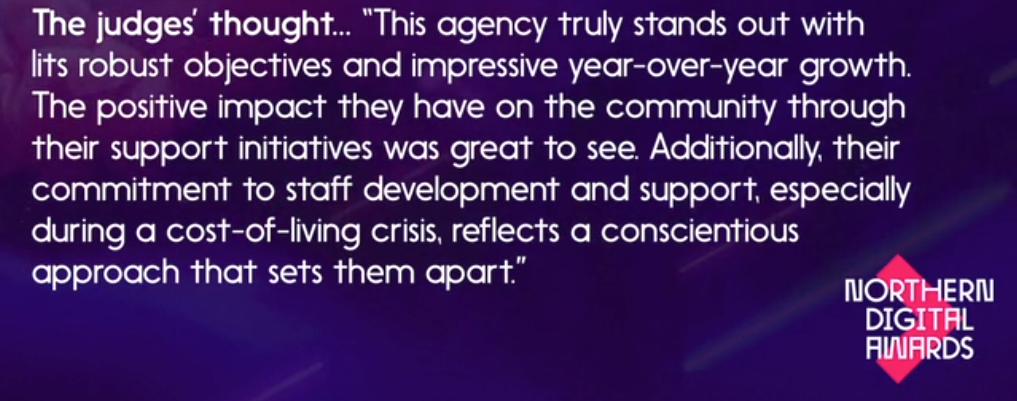
We are so pleased with this outcome, especially given the tough competition from a host of esteemed agencies. It’s really exciting to see our hard work this year recognised through such respected awards.
Here’s what the judges had to say:
Thank you to our clients for another successful year, and a huge well done to the team for their efforts!
Cedarwood Nominated For 12 UK Search Awards!
What a great way to end the week! ⚡️ – We’re delighted to announce that Cedarwood has been nominated for 12 UK Search Awards after our best year ever for digital marketing performance.
The nominations follow on from our success last year where we won:
🎊 Best Use Of Search (Finance)
🎊 Best Use Of PR In Search (Silver)
🎊 Best SEO Agency (Silver)

We have been nominated for:
💥 Best Use Of Search (Finance) x2
💥 Best Use Of Search (Retail PPC)
💥 Best Use Of Search (B2C)
💥 Best Use Of Search (Health)
💥 Best Use Of Content Marketing
💥 Best Use Of PR In Search x2
💥 Best Use Of Data (PPC)
💥 Best PPC Agency
💥 Best SEO Agency
💥 Best Integrated Agency
The event will be held at Bloomsbury Big Top on November 30th and we are looking forwards to seeing everyone on the night! You can find a full list of all nominees here: https://searchawards.co.uk/2023-shortlist/
Five Key Tips To Create An Effective Digital PR Campaign
Digital PR has been a buzzword in the world of online marketing for quite a while now and it’s a popular marketing approach for businesses who are looking to grow their online profile while also landing important links back to their website.
Here at Cedarwood, digital PR has always been an important part of our service offering, not just for the visibility that it garners for our clients, but also for the positive impact it can have on SEO campaigns and as a result we have a lot of experience (over seven years direct experience in fact!) in rolling out effective digital PR campaigns.
Although it is one of the more popular approaches within the SEO mix, digital PR is something which if not done properly can fail to have the desired impact – so below we’ve included some top tips on how you can go about creating an effective digital PR campaign.
The importance of Digital PR
Before we dive into five key tips to creating an effective digital PR campaign, let’s first look at why digital PR is important and how it can help you to achieve your goals across both SEO and also improving overall awareness.
Digital PR is important because it can help businesses achieve a number of goals, including:
➡️ Increase brand awareness: When your brand is featured in high-quality, relevant publications, it can help to raise awareness of your company and its products or services. This can lead to increased traffic to your website, more leads, and ultimately, more sales.
➡️ Generate leads: A well-executed digital PR campaign can also help to generate leads for your business. When journalists and other influencers write about your company, they often include a call to action, such as a link to your website or a way to sign up for your email list. This can help you to capture the contact information of potential customers who are interested in learning more about what you have to offer.
➡️ Improve SEO: When your brand is mentioned in high-quality, relevant publications, it can help to improve your website’s search engine ranking. This is because search engines take into account the number and quality of backlinks to a website when ranking it in search results.
➡️ Build relationships with journalists and influencers: Digital PR can also help you to build relationships with journalists and other influencers in your industry. These relationships can be valuable assets for your business, as they can help you to get your company featured in the media and reach a wider audience.
There’s a lot of value that you can add to your overall marketing mix with digital PR but it’s important to understand how it fits in with a broader marketing mix, so that you can understand how to utilise it effectively.
Five Key Tips
- Start With Your Strategy
Strategy plays a key role within your digital PR campaigns and understanding your client’s audience, the current landscape and the type of content that will resonate with your audience (and journalists!) is important to driving success.
So let’s start off with some key considerations and questions to ask around your digital PR strategy:
➡️ Your target audience: Who are you trying to reach with your digital PR campaign? What are their interests? What are their pain points?
➡️ Your goals: What do you want to achieve with your digital PR campaign? Do you want to increase brand awareness? Generate leads? Improve SEO?
➡️ Your key messages: What are the key messages you want to communicate with your digital PR campaign? What do you want journalists and influencers to take away from your story?
➡️Your content: What type of content will you create for your digital PR campaign? Will you write blog posts? Create infographics? Produce videos?
➡️Your distribution strategy: How will you distribute your content? Will you share it on social media? Submit it to media outlets? Pitch it to influencers?
➡️ Your measurement strategy: How will you measure the success of your digital PR campaign? Will you track website traffic? Leads generated? SEO ranking?
It might seem like a lot, but putting time into understanding your target audience, goals and distribution strategy will save you a lot of time further down the line so invest the time early on to ensure you are driving maximum efficiency through your campaigns.
2. Do You Research
Undertaking research at the start of a digital PR campaign is another way to ensure you save time further down the line, don’t repeat stories which have already been covered and really maximise your outreach capacity and capabilities.
When you’re doing your research for a digital PR campaign, there are a few key things to keep in mind:
➡️ Identify your target audience: Who are you trying to reach with your campaign? What are their interests? What publications do they read? What influencers do they follow?
➡️ Identify the right publications and influencers: Once you know who your target audience is, you can start to identify the right publications and influencers to reach out to. Consider the following factors when making your selection:
➡️ Relevance: The publication or influencer should be relevant to your target audience.
➡️ Reach: The publication or influencer should have a large enough audience to reach your target audience.
➡️ Credibility: The publication or influencer should be credible and respected by your target audience.
➡️Find out what they’ve written about in the past: Take a look at the publications and influencers you’ve identified and see what they’ve written about in the past. This will give you a good idea of their style, their interests, and the types of stories they’re interested in.
➡️ Find out how to contact them: Once you’ve identified the right publications and influencers, you need to find out how to contact them. This may involve finding their email address, phone number, or social media profiles.
By doing your research, you can increase your chances of success with your digital PR campaign.
Here are some additional tips for doing your research:
➡️ Use online tools: There are a number of online tools that can help you with your research, such as Google News, Cision, and Meltwater. These tools can help you to find relevant publications, influencers, and stories.
➡️ Talk to people in your industry: Talk to people in your industry who are familiar with digital PR. They can share their insights and advice with you.
➡️ Attend industry events: Attending industry events is a great way to meet journalists and influencers and learn more about their needs.
Taking additional time to thoroughly research all of the above and build your contact list can really help when it comes to outreaching the campaigns, so make sure you put the groundwork in before you start building the campaigns to maximise the success.
3. Create High Quality Content
If you want journalists to link to your website then you need to generate great content which gives them a reason to link to it. So whether it’s a data piece, a piece of thought leadership or just something of genuine interest to the user, make sure that the content you create is relevant, up to date and most importantly, within the user interest.
Great content for Digital PR comes in a number of different formats and can include:
➡️ Data-driven content: This type of content uses data and statistics to tell a story. It can be very persuasive and can help you establish yourself as a thought leader in your industry. For example, you could create a blog post that analyzes industry trends or a report that provides insights into your target audience.
➡️ Compelling visuals: Images, infographics, and videos can be very effective at engaging your audience and driving traffic to your website. Make sure your visuals are high-quality and relevant to your content.
➡️ Interviews and thought leadership pieces: Interviews with experts in your industry can be a great way to generate backlinks and establish yourself as a thought leader. You could also write thought leadership pieces that share your insights on industry trends or best practices.
➡️ Case studies: Case studies can be a great way to demonstrate the value of your products or services. They can also help you generate leads and build relationships with potential customers.
➡️ Trendjacking: Trendjacking is the practice of capitalizing on current trends to create content that is relevant and timely. This can be a great way to generate buzz for your brand and attract new customers.
Undertaking the first two steps will help you to better understand the audience and it’s important to keep this in mind when creating high quality content to ensure that when you outreach it to journalists it’s going to be relevant to both their audience and yours.
4. Promote Your Content
In the simplest terms promoting your content is essentially outreaching it – getting it in front of journalists to ensure that you get the right level of coverage for your client, at the right time. The promotion of the content is almost as important as the quality of the content if not more so, as it doesn’t matter how great your content is, if no one sees it then it will have no impact on your overall marketing efforts!
When outreaching to journalists the first step is to create an effective media list – remember – you don’t have to include everyone on your media list, rather focus on the contacts that count, people who are likely to cover your story or who have a genuine interest in what you are doing.
Here are some top tips to land coverage with journalists:
➡️ Do your research. Before you reach out to any journalists, take the time to learn about their work and their audience. What kind of stories do they typically write? What are their interests? Once you have a good understanding of their needs, you can tailor your pitch accordingly.
➡️ Make a great first impression. Your subject line is the first thing a journalist will see, so make sure it’s clear, concise, and attention-grabbing. The body of your email should also be well-written and engaging. Get to the point quickly and clearly, and make sure your pitch is relevant to the journalist’s interests.
➡️ Be helpful and responsive. If a journalist is interested in your story, be prepared to provide them with all the information they need. This includes high-quality images, videos, and other supporting materials. Be responsive to their questions and requests, and make sure they have everything they need to move forward with the story.
➡️ Be patient. It takes time to build relationships with journalists. Don’t expect to get a response from every pitch you send out. Just keep pitching good stories, and eventually you’ll start to get results.
You won’t always get it right first time, but taking your time to build out media lists & prepare them effectively will play a key role in ensuring that you are maximising the most of your opportunity.
It’s also important to stand out – in a crowded area where journalists receive hundreds of PR pitches each day, how do you make sure that you stand out from the crowd?
➡️ Personalize your pitches. Don’t just send out a generic email to a list of journalists. Take the time to address each journalist by name and tailor your pitch to their specific interests.
➡️ Offer exclusive content. If you can offer journalists exclusive content, they’ll be more likely to take a look at your pitch. This could be a press release, a white paper, or even an interview with an expert.
➡️Be persistent. If you don’t hear back from a journalist right away, don’t give up. Follow up with them a few days later to see if they have any questions.
Timing is also key – ensuring that you outreach at the right time to the right person plays a key role in getting the coverage that you are looking for.
5. Measure Results
Measuring results and evaluating your digital PR campaigns plays a key role in ensuring that you get the most out of them and that you can take learnings to continue to evolve and improve your offering. Digital PR is constantly changing and evolving, so staying on top of your game is key and ensuring that your clients understand the value of what you are offering plays a key role in ensuring that you’re showcasing the value that you are bringing.
To start with, you need to be clear about what you want to measure, approaches here include:
➡️ Set clear goals: Before you launch your campaign, set clear goals for what you want to achieve. This will help you track your progress and measure your success.
➡️ Use a variety of metrics: Don’t rely on just one metric to measure the impact of your campaign. Use a variety of metrics to get a more complete picture of your results.
➡️Track your results over time: Don’t just measure the impact of your campaign at the end. Track your results over time to see how your campaign is performing.
➡️Make adjustments as needed: If you’re not seeing the results you want, make adjustments to your campaign strategy.
Don’t be afraid to make updates and changes as you need – this will help you to ensure you keep firmly fixed on the overall goal of delivering value to your clients and the reach/coverage that they want.
You can use a number of different ways to measure from a metric perspective, but here are some of the most common metrics:
➡️ Media coverage: This is the most basic metric, and it simply measures the number of articles, blog posts, and other pieces of media that mention your brand.
➡️ Link building: This metric measures the number of links to your website from other websites. Links are important for SEO, so this metric can give you an idea of how well your campaign is helping to improve your website’s search engine ranking.
➡️Social media engagement: This metric measures the number of likes, shares, and comments on your social media posts. It’s a good way to measure how well your campaign is resonating with your target audience.
➡️Brand awareness: This metric measures how well people know your brand. You can measure brand awareness through surveys, polls, and social media analytics.
➡️Website traffic: This metric measures the number of people who visit your website. It’s a good way to measure the overall impact of your campaign, as more traffic means more people are learning about your brand.
Whichever you use, it’s important to remember that you always need to be linking it back to revenue and results for your client – these are there key business metrics, so make sure to keep in mind how it closely links back to what your client is looking to achieve.
Final Thoughts
In addition to everything that we have mentioned above, at the end of the day an effective digital PR campaign all comes down to whether the user consumes it, engages with it and feels something for it – after all we are trying to create something which sits within the human interest angle.
Keeping this in mind, additional elements which will play in to the success of your campaigns include:
- The quality of your relationships with journalists
- Your ability to generate buzz and excitement around your content
- Your ability to adapt your strategy as the campaign progresses.
Each of these play their own important role in ensuring that your campaigns get off the ground, so in addition to some great planning and activation make sure you take the time to build the relationships and research the impact of your content – this is essential to gaining that all important coverage!
To find out more about how we can help you with your digital PR campaigns, get in touch!
![[blog]_[why is relevancy so important in digital pr]_[Blog Pictures]](https://cedarwood.digital/wp-content/uploads/2024/08/Copy-of-Blog-Image-Template-39-900x506.png)
![[blog]_[why collaboration between SEO and digital PR is so important]_[Blog Pictures]](https://cedarwood.digital/wp-content/uploads/2024/06/Collaboration-Between-Digital-PR-And-SEO-Blog-Image-900x506.png)
![[blog]_[a guide for e-commerce digital pr]_[Blog Pictures]](https://cedarwood.digital/wp-content/uploads/2024/06/Copy-of-Blog-Image-Template-35-900x506.png)
![[blog]_[Director Amanda On The Main Stage At Brighton SEO]_[Blog Picture]](https://cedarwood.digital/wp-content/uploads/2024/04/wpimage-id13321width562pxheightautosizeSluglargelinkDestinationnone-figure-classwp-block-image-size-large-is-resizedimg-srchttpscedarwood.digitalwp-contentuploads202507Image-1-1024x-3-900x506.png)
![[blog]_[Core Web Vitals - What Is It & How Do I Find Out If I Pass?]_[Blog Picture]](https://cedarwood.digital/wp-content/uploads/2024/04/Untitled-design-41-900x506.png)
![[blog]_[70 Free Data Sources For Your Digital PR Campaigns (All In One Place!)]_[Blog Picture]](https://cedarwood.digital/wp-content/uploads/2024/03/wpimage-id13321width562pxheightautosizeSluglargelinkDestinationnone-figure-classwp-block-image-size-large-is-resizedimg-srchttpscedarwood.digitalwp-contentuploads202507Image-1-1024x-59-900x506.png)
![[blog] [northern digital awards] [blog picture]](https://cedarwood.digital/wp-content/uploads/2024/01/How-we-delivered-100-top-tier-links-by-jumping-on-a-trending-topic-900x506.png)

![[case studies[ [uk search awards finlaist] [case study templates]](https://cedarwood.digital/wp-content/uploads/2023/10/How-we-delivered-100-top-tier-links-by-jumping-on-a-trending-topic.-3-900x506.png)

![[blog]_[Five Key Tips To Create An Effective Digital PR Campaign]_[Blog Picture]](https://cedarwood.digital/wp-content/uploads/2023/06/Untitled-design-25-900x506.png)
![[blog]_[Backlinks and Brainteasers: a marriage made in SEO]_[Blog Picture]](https://cedarwood.digital/wp-content/uploads/2021/02/Untitled-design-74-900x506.png)


![[blog]_[Improve Email Response Rate: Small Changes That Make A Big Difference]_[Blog Picture]](https://cedarwood.digital/wp-content/uploads/2020/11/Untitled-design-75-900x506.png)


![[blog]_[ 5 simple lead generation ideas ]_[Blog Pictures]](https://cedarwood.digital/wp-content/uploads/2020/11/Untitled-design-14-900x506.png)